In Argentina, wine and football (soccer) are not hobbies, they are close to national institutions.
Between the 1880s and the 1930s, roughly six million immigrants landed in Argentina, most of them Italian, followed by Spaniards, and a smaller number of French and British. They brought the Mediterranean habit of treating wine as a daily staple, something that belonged on the table alongside food. Football came with them. A century later, both have only grown more central to Argentine life. Wine is the national drink; football is followed with an intensity that borders on devotion. When the national team plays, supporters of clubs that are otherwise bitter rivals are united.
The passion cuts across class and geography. Nearly every neighborhood has its own club, and fans often follow two at the same time, a big Buenos Aires team and a local one that might be a few divisions down. Expertise is just as widely distributed across classes. A bus driver or a building doorman can carry out a detailed match analysis with a doctor or lawyer. Wine has taken a similar hold. Argentina was long a volume market, where people drank a glass or two with lunch and dinner without much thought. As overall consumption has fallen, a more serious wine culture has grown up in its place, with collectors, home cellars and a young generation of sommeliers in Buenos Aires who embrace the trade with great devotion.
Few families illustrate the wine side of that history better than the Catenas.
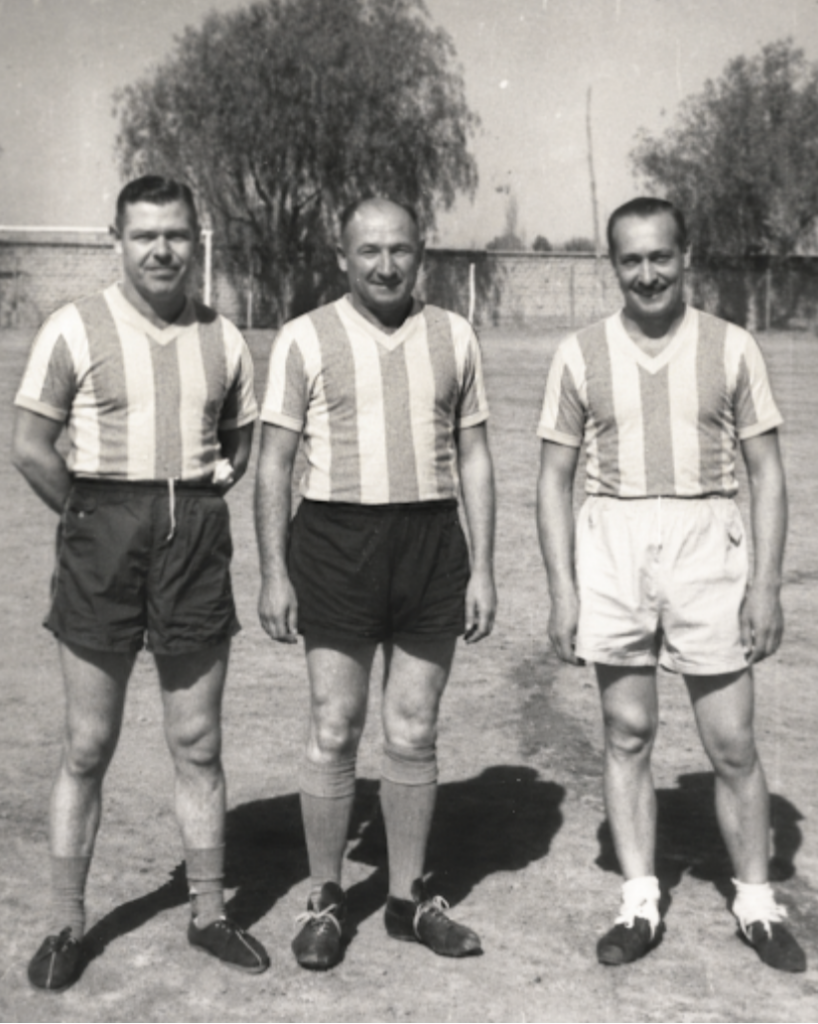
It started with Nicola Catena, an Italian immigrant from the Marche region. He left a famine-stricken homeland in 1898 and settled in Mendoza, the high-altitude province that now produces roughly 80% of Argentina’s wine. In 1902 he planted his first Malbec vineyard – a grape then used mainly for blending in Bordeaux and largely dismissed elsewhere.
His son Domingo built the business into one of the largest vineyard holdings in Mendoza. But the family’s reinvention came under Domingo’s son, Nicolás Catena Zapata, an economist who taught briefly at the University of California, Berkeley, in the 1980s. He modernized the winery’s methods and pushed vineyards higher into the Andes than most growers thought viable, planting the Adrianna Vineyard in Gualtallary at close to 5,000 feet. The wines that followed put Argentina on the international map.
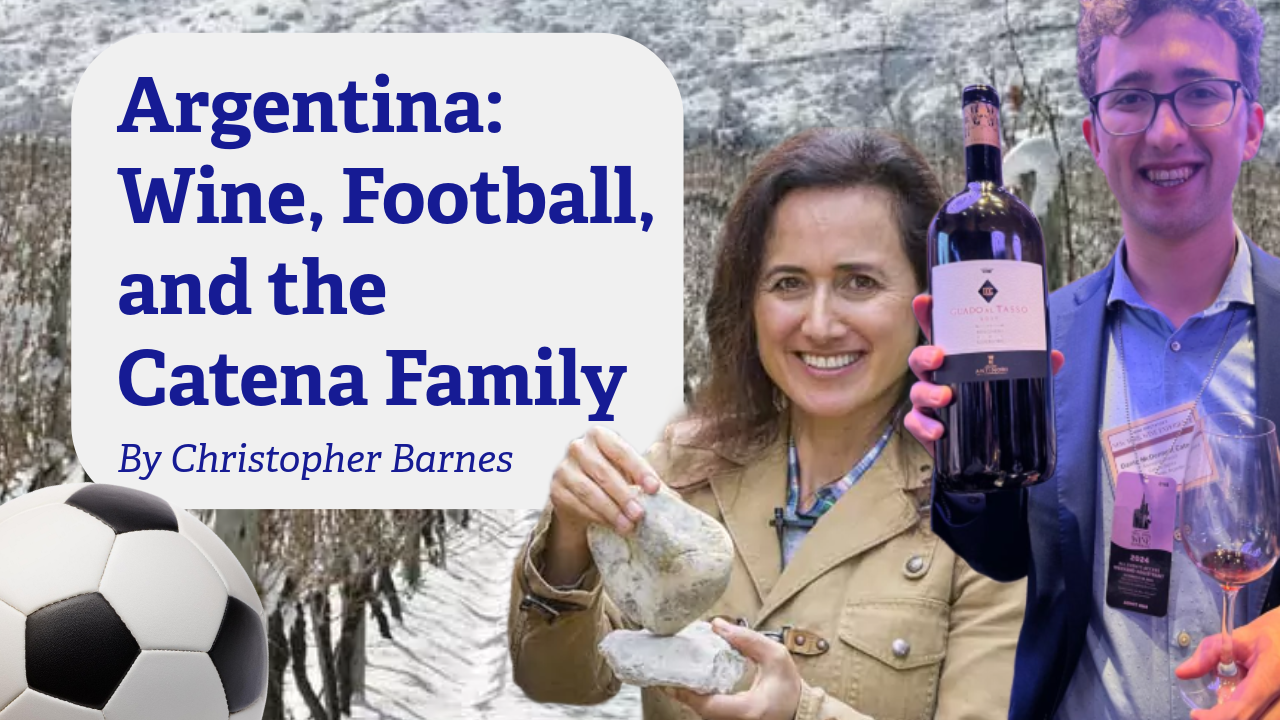
The winery, now the oldest in Argentina still in its founding family’s hands, is led by Nicolás’s daughter, Dr. Laura Catena. A fourth-generation vintner, she has an unusual résumé: a Harvard-trained biologist and Stanford-trained physician who worked in emergency medicine. In 1995 she founded the Catena Institute of Wine to study Argentina’s high-altitude terroir. The fifth generation is represented by her son, Dante, who discusses the national team with the same command his family brings to the vineyard.
Grape Collective spoke to Laura and Dante shortly before the Argentine national team’s incredible comeback victory in the world cup over Egypt. Laura and Dante discuss how wine and football took hold in Argentina, how the country’s drinking habits shifted from volume to connoisseurship, and how they watch matches at home, usually on edge.
A conversation with Laura and Dante Catena:
hhh
hhh
Christopher Barnes: Argentina has this really passionate wine culture, and also a really passionate football culture. There’s a lot of European influence in Argentina – talk a little about how that happened.
Laura Catena: There was a huge wave of immigration – six million people came to Argentina in the 19th century. One of them was my Italian great-grandfather, and Dante’s great-great-grandfather, Nicola Catena, who came from the Marche region of Italy. Along with him came many Spaniards, many Italians, and also some French and some British – people from all over.
The main immigration was Italian, actually, and then Spanish. And these people wanted to drink their wine, because they came from cultures where wine was part of daily life. It was like food – the Mediterranean diet. So people like my great-grandfather said, “This is a business opportunity.” He was from a tiny village where they were basically vineyard workers, with a small home production of olive oil and wine. He thought, “I can go to Argentina and own my own vineyard.” That’s why he came.
And this culture of drinking wine is part of who we are. We’re not big beer, spirits, or cocktail drinkers – we mostly drink wine. Wine is the national beverage; it’s institutionalized by the government as ‘la bebida nacional’, like our flag. Our colors are light blue and white, our national beverge is wine, and our sport is football.
Talk a little about how passionate Argentina is about its football.
Dante Catena: For me it’s amazing. One thing that connects football and wine is that both bring people together. When you meet a friend for happy hour, you’re drinking wine; when you’re having an asado with your family, you’re drinking wine. Football is the same. Every neighborhood has its club, and people are often fans of multiple clubs at once – a big club in Buenos Aires, and then, if you’re in Mendoza, a neighborhood club that might be in the third or fourth division, where your uncle might play.
So there’s this culture of sharing football. And with the national team it’s really amazing, because all these teams that historically hate each other are suddenly singing the same songs together and in the stadium, outside the stadium, at home. When you watch the game, you can hear the chants through the TV; you can hear our fans even when the match is in the United States, a ten-hour flight away. For me that’s really special. It’s just passion – and there is a passion for wine, too. People in Argentina get really nerdy about wine; we have a great community of young sommeliers in Buenos Aires.
vv
So how do different people from different backgrounds in Argentina come together over their national love of the game?
Dante Catena: I think it’s amazing. It’s a huge country – you have the Pampas, the mountains, the more tropical region in the north, Patagonia – and people from anywhere can be a professor of football. You could have a doctor, like my mom, walk into a bar knowing the least about the game of anyone there. You can talk to your bus driver for ten minutes about football, or the person cleaning the building, or anybody – and everybody shares the game together, no matter who you are. That’s always really special.
Laura Catena: And there’s always an expert in every office. Here at our winery office in Buenos Aires, there are the people who know about football, and we go to them to find out what’s going to happen – they’re professors of football. There are people like that in every office, every building, every part of the country, down to the tiniest village.
And, as Dante mentioned about wine — Argentina used to be a volume drinker, very much like Italy, Spain, and France, where people just drank a couple of glasses with lunch and a couple with dinner. The movement toward drinking less has happened in Argentina too, and it’s morphed into a culture of serious wine enthusiasts who know the varieties, the regions, the brands, who collect, who keep a little cellar at home. It’s fascinating to see how Argentina moved from drinking wine like water — because when my dad was a kid it was literally safer to drink wine than water – to today’s culture of wanting to know every detail of wine, in a similar way to football. Though football was probably there before wine.
So, a couple of follow-up questions. Dante, how nervous were you during the Cape Verde game?
Dante Catena: Oh, I was shaking. I was sweating and shaking, and I had to get up and walk around the coffee table several times. It was an unbelievable match. Cape Verde were so impressive – I don’t think anybody expected it; they probably didn’t expect it themselves. All their players worked together, linked up, holding each other up. It was so impressive.
And for Argentina, it’s something we’ve seen from the national team every time: when we get punched, when we get put down, when we give up a goal, there’s always a response. We couldn’t put Cape Verde away, they just kept coming back. We scored early in extra time, and they responded with one of the most amazing goals I’ve ever seen in a World Cup. And then there was this coming-together of the players – they looked at each other with all their experience and knew, “Okay, we’re good, we’re going to be fine.” They went out and scored the last goal with just a few minutes left. That resilience on both sides, the resilience and the desire to win – was just impressive. One of the best World Cup games I’ve ever seen.
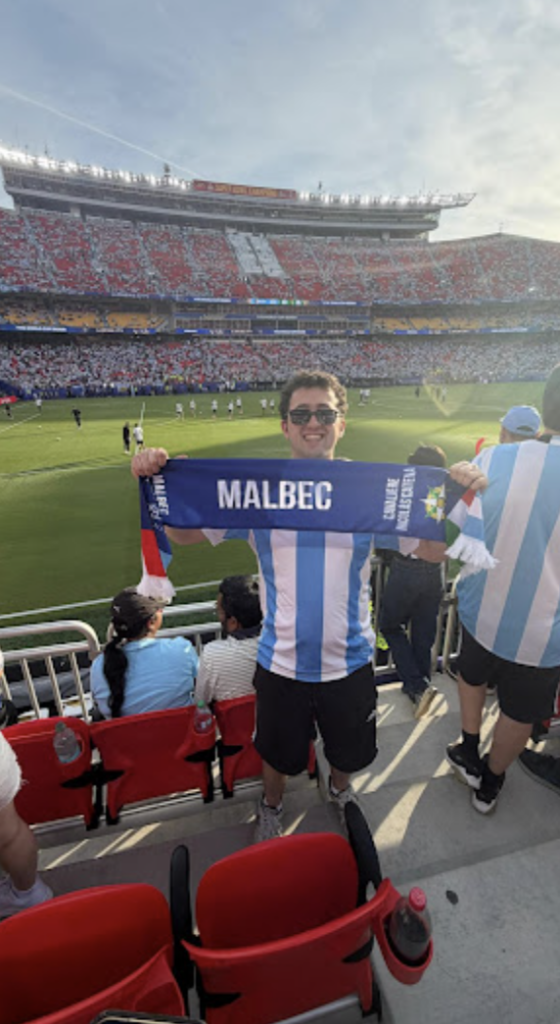
It reminds me of the beauty of sport — bringing different communities, regions, and countries together in a celebration of athleticism. It was an incredible game. I was born in Argentina, so I wanted Argentina to win, but like everybody else, I also wanted Cape Verde to win, because it’s just such a great story, right?
Laura Catena: Wait — you were born in Argentina?
I was born in Buenos Aires. My father was a journalist.
Laura Catena: That’s so cool. I didn’t know that.
Yeah. He wrote one of the first books about Eva Perón — the one that came out around the same time as the musical – so I still get a residual check for about $20 every now and then.
Laura Catena: That is so cool. You know what I also enjoyed? We have this rivalry with Brazil, and yet Brazil is also a friend in Latin America – we’re business partners, we sell a lot of wine there. In fact, we did something a lot of Argentines might not like: we made little dog bandanas with “Catena” in the yellow Brazilian color, and people had watch parties with them. Some people at the office said, “Laura, you can’t mess with that.” I said, “Why not? They’re our rivals, but we admire them.” And then there’s Cape Verde – they speak Portuguese, so it was kind of cool that it was a foreign language, but also one we’re very familiar with in Argentina. There was this crazy connection between the two teams. And at the end, where Messi gives them his shirt. I was literally crying during that scene. It was amazing.
Amazing game. Dante, you might be a little too young for this, but one of the most famous moments in football history has to be the Hand of God. I grew up in England, so it’s something we all know too well. How do you compare Maradona — this amazingly great, enigmatic character with Messi, who is equally stunning in his abilities?
Dante Catena: My gosh. I can only speak from what I’ve seen on YouTube, but from that it seems Maradona had this thing of keeping the ball on a string – no matter where it was, he could get to it and control it, even straight out of the air. You could drop a football from space and he’d control it. Messi is also an amazing dribbler, one of the best we’ve ever seen, but he has more of the vision for ending up at goal. Messi can control a long ball better and is probably better at shooting from long range; I think he can plan five or ten passes in advance in a way Maradona maybe couldn’t. That’s my analysis.
And personality-wise, they could not be more different. Maradona was this crazy guy who lived for football – everything he did was football – but he also had his social life, being a partier, with some scandals toward the end of his career. Messi is very controlled. When he speaks to the media it’s textbook: “It’s just about the team winning.” He avoids attention. Maradona was the complete opposite.
With wine drinking – in American sports culture you often get people drinking a lot of beer in bars. If you were watching a World Cup in a bar in Argentina and drinking wine, what kind of wine would you be drinking?
Laura Catena: I’ve spent more time in Argentina than Dante, but I generally watch the games at home, alone with my family. Dante, maybe you talk about the tradition — there’s Fernet and Coke.
Dante Catena: And there’s beer, there’s a culture of other drinks too, but some people will order a Malbec, or a sparkling wine, or something lighter – even something low-alcohol; we have our no- and low-alcohol wines now. There are very different types of fans. In my family, we’re all too nervous to be around a lot of people during the game. For a knockout game, we don’t want to be at a bar – we’re too nervous, we don’t want to talk to anyone. If somebody talks to me during a knockout game, I kind of pretend to ignore them.
So it’s very different. Watching at home, we might have a complex red – maybe a Pinot Noir. And the celebration wine, or the depression wine after the game, is very important: if you lose, a heavy red is always in store; if you win, you’re celebrating with a sparkling or a white.
Laura Catena: There’s also a big vermouth culture in Argentina — people drink it with Coke or Diet Coke, and that would be the traditional drink at a bar while watching a game. But like Dante said, Argentina today is different. We do the Fernet, but we were at a bar the other day and people were drinking wine. The culture has changed, maybe the same way it has in other countries – now people drink all kinds of things, and there are basically no rules.
Dante, if you were to think of the players on Argentine team, what wines would you compare them to?
Dante Catena: To start, I’d go with one of our favorite wines from Catena: the River Malbec, from the vineyard. It was originally called River Stones, but we had to change it to River. What’s been really funny is that now that we have the wine River, there’s a soccer club called River Plate – and all the River Plate fans, even the former players, want to drink that wine. So the River Malbec has to be a River Plate player. The most famous one on the national team is Julián Álvarez. This World Cup he hasn’t started as much, because he and Lautaro Martínez have alternated, but he’s easily our best River Plate player. So he’d be the River Malbec – this wine and this player both hold a strong place in my heart.
Nicolás Otamendi for Nicolás Catena – a perfect fit. Otamendi is one of our legends; he’s now playing in his fourth World Cup, which is amazing, as a center back. He’s kind of the grandpa of the team, along with Messi – which makes sense, because Nicolás is my grandfather – and it’s a strong blend of Malbec and Cabernet Sauvignon. It has this power to it that I think is really nice, but it still has skill and finesse, with complexity and soft tannins. So that’s a good comparison for Otamendi.
This next one is fun. One of the heroes of the national team is the goalkeeper Emiliano Martínez, and I’d venture toward our Cabernet Franc. Martínez is a spicy, controversial player. You might remember the shootout in the final, where he pretended to hand the ball to one of the French players and then chucked it across the field – it was amazing. He’s one of the best goalkeepers in shootouts, and in mentality. I think that matches the Cabernet Franc: it’s sturdy, but it has this spice to it, sometimes almost peppery. So the Cabernet Franc is a good comparison for him.
We also have Fortuna, from the vineyard. This one’s interesting, because “fortuna” means luck in Latin – so that would be Gonzalo Montiel, the last penalty taker in the World Cup final, who scored the goal that clinched it for Argentina. It was a penalty to the left, and the goalie went the other way, so he was lucky enough to have that. That’s why he’s connected to Fortuna.
And I always like to bring a Pinot Noir, because I love Pinot Noir – that would be Nico Paz. He hasn’t been a starter yet, but he’s this next generation; a lot of people think he’s the next player to fill Messi’s role. Not that anyone could replace Messi, but he’s a great dribbler and a creative player. I’d say he’s like Domaine Nico, one of our Pinot Noirs from Argentina. And, Laura, you have another comparison, right?
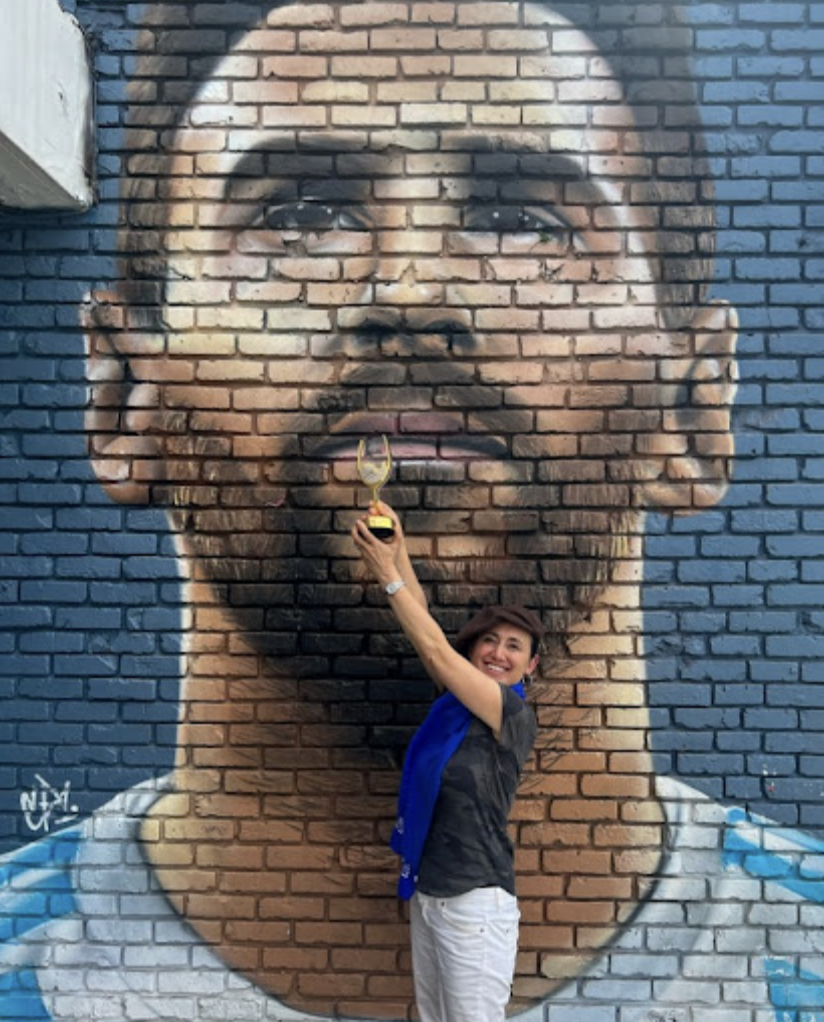
Laura Catena: Yes. Messi as the Malbec Argentino, which is really interesting, because it comes from old vines. It’s the label with the four women, and I love that Messi isn’t twenty-something and yet he’s literally the best player in the world. These old vines are stars, and they make this incredible wine. I love old-vine wine, and this parallel between Messi and old vines – the wisdom that comes from age, reflected in both a wine and a player – is why I love that wine for Messi.
Dante Catena: It’s a great comparison, because with old vines there’s a parallel to be made: a lot of people were saying Messi shouldn’t play this World Cup, or should come off the bench. The same thing happens with old vines – people say, “Let’s pull out the old vines.” But no – keep the old vines, keep Messi in the starting lineup, and everything will be great.