When will this wine be at its peak? In the universe of wine questions, that’s way up there. And the quick answers are: 1) Most wines are meant to be drunk right away and 2) In terms of fine wine, it’s impossible to know because every bottle is different and a great deal depends on storage and handling.
This is the story of one bottle. Was it at its peak? Too early? Too late?
We recently celebrated the 52nd anniversary of the day we met. All anniversaries are special to us – we also celebrate our wedding anniversary – but the stars really aligned for this one. Our anniversary coincided with the New York Philharmonic’s annual free concert in Central Park.

We have been attending concerts in Central Park pretty much since we met – Metropolitan Opera, Philharmonic, even Simon & Garfunkel in 1981, back in the day when vendors walked among the crowd yelling “Loose joints, loose joints.” We have always taken interesting wines with us and we learned one of our most important lessons about aging wines right there in the park. At a different concert in 1981 — there used to be four every year but now, alas, there’s only one — we took two bottles of Louis Martini from 1974, a Pinot Noir and a Cabernet Sauvignon. We drank a lot of those back then because they were solid wines and they cost $5. We’d bought these a few years before and just kind of forgot we had a couple of them.
These were not sold as wines to lay down. They were meant to open that night with pizza and friends. But we were astounded: They were gorgeous, wholly different wines than they had been a few years earlier. They had gained a depth and complexity we never imagined.
Fluke? Maybe. For all we know, just a month or two later we would have opened these and said, darn, we should have drunk them sooner. It’s pretty rare that we open a bottle and say to each other that this is it – the wine was not better yesterday and would not be better tomorrow. In 1992, we drank a 1979 Château Montrose that was at its peak that moment and we never forgot it, as you can tell.
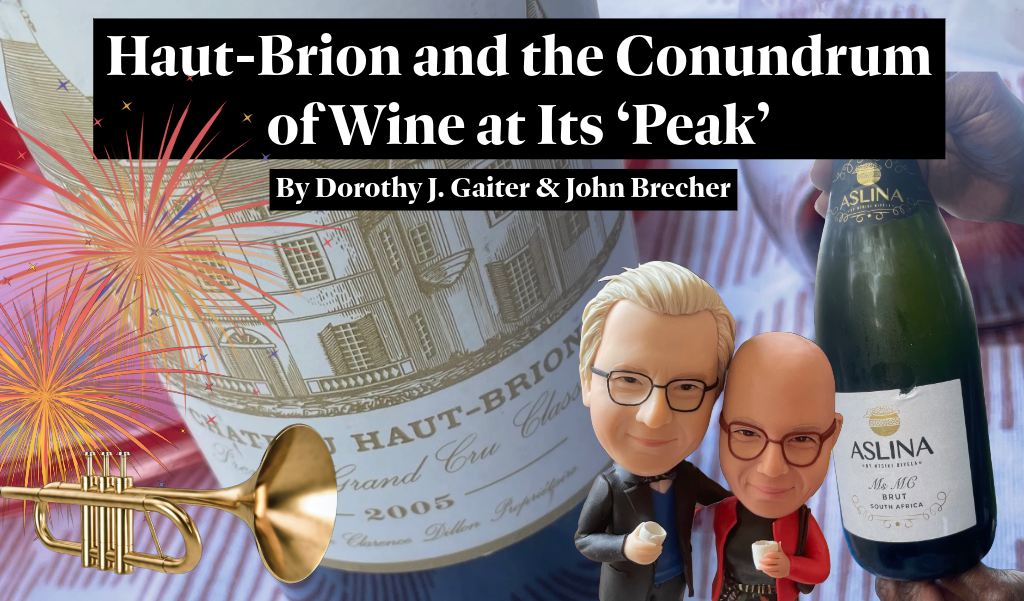
This year, for our anniversary, we decided to take to the concert a 2005 Château Haut-Brion from the Pessac-Léognan appellation in Graves, one of the great first growths of Bordeaux, a storied lineup that includes Lafite, Latour, Margaux and Mouton-Rothschild. The Haut-Brion was 56% Cabernet Sauvignon, 39% Merlot and 5% Cabernet Franc. We’re not big wine collectors, but we have picked up a first growth from time to time along the way. We rarely actually drink them because – well, how often does any wine lover drink a first growth? And we have never taken one to the park because the conditions are, in some ways, suboptimal. It’s hard to regulate the temperature once the wine is out of the wine cooler, it’s challenging to decant if needed and it’s weird to geek out about a wine around thousands of people sitting on blankets.
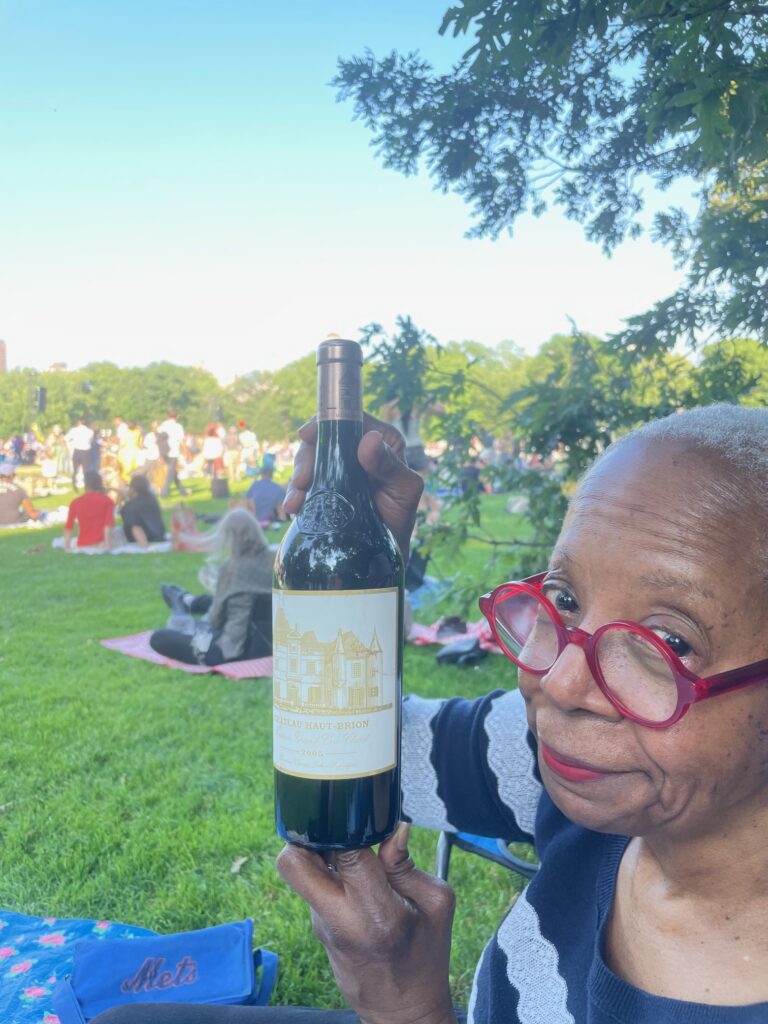
This was a very good vintage and Robert Parker raved about it in the Wine Advocate in 2015 while Neal Martin, writing for the Advocate, gave it 98+ points. To give you an idea about how you never know about aging, Parker suggested that the “drink date” for the 2005 was 2015 to 2045. Wow. In 2045, our just-born grandson will be graduating from college. We tasted this 2005 when it was released ($1,295) along with the other first growths for our column in The Wall Street Journal and loved the Haut-Brion enough to buy one for ourselves. We never really thought about laying it down for 20 years, but we just didn’t open it.
Sometimes, you just have to grit your teeth and pull the cork on a treasure. We did, after all, invent Open That Bottle Night. So we packed up a picnic from Zabar’s and headed out.
We opened the bottle at 6:28. The cork was in excellent condition (we bought this from a reputable dealer and have kept it in cellar conditions). Even in the park, both of us could smell the wine before John poured it. The nose was filled with dark fruits and minerals and sage.
He poured. It looked gorgeous, without a hint of age on the rim. And then the first sip.
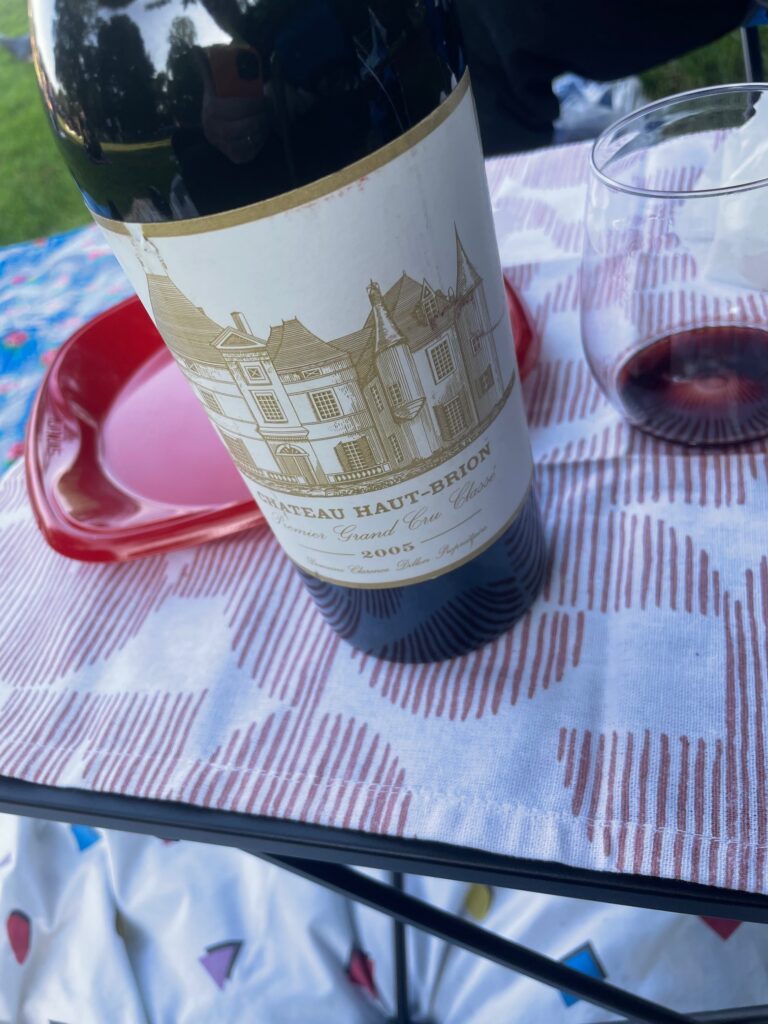
Dottie said later, “Everyone who loves wine should have an opportunity to experience this.” It was explosive, still very young and fresh, with pitch-perfect acidity and well-balanced tannins. The tiniest sip seemed to fill our mouths with blackberries, blueberries, minerals, rich earth and spices.
These days, people talk about “big red wines.” To us, though, too often “big red wine” translates to heavy, sweet, overly chewy and oaky and difficult to enjoy after the first glass. This was big in a much different way. It was chiseled.
When we were much younger, we used to take trains all across the U.S. and Canada. In fact, we once had a 1988 Haut-Brion on the Silver Meteor from Miami to New York. “Extraordinary power and depth,” we wrote. One of our favorite sights on those trips from the East was the sun setting over the mountains in the West. There was something indescribably elemental to that sight. This full-bodied wine tasted like that – elemental, kind of like embracing those majestic peaks. John even mentioned that he felt he was licking a red rock.
We did not decant, though we gave ourselves generous pours initially to get some air to the wine. We wanted to taste every drop as the wine opened and revealed itself, and as Gustavo Dudamel led the Philharmonic though Tchaikovsky’s Symphony No. 4 in F minor, Opus 36. The wine was unchanged as we then thrilled to Arturo Sandoval’s blazing horn in his brilliant Concerto for Trumpet No. 2, which ended in roaring approval. The wine stayed true, not losing a step, concentrated and earthy with a granite underpinning, mushrooms, dark fruits and a little smoke. We thought for a few minutes that the smoke from Canada’s wildfires might have contributed to the latter, but it also could have been from the repaving efforts on Central Park West.
After cuatro genius Jorge Glem’s gripping performance of Gonzalo Grau’s Odisea: Concerto for Venezuelan Cuatro and Orchestra, we put a cork in the Bordeaux and pivoted to a sparkler from Aslina, from South Africa, which was delicious on its own and with the picnic of duck mousse, slabs of feta (French and Greek), grilled cod and black olives. The refreshing, palate-tingling pivot gave the Haut-Brion some more time to evolve, though we could not imagine it getting better.
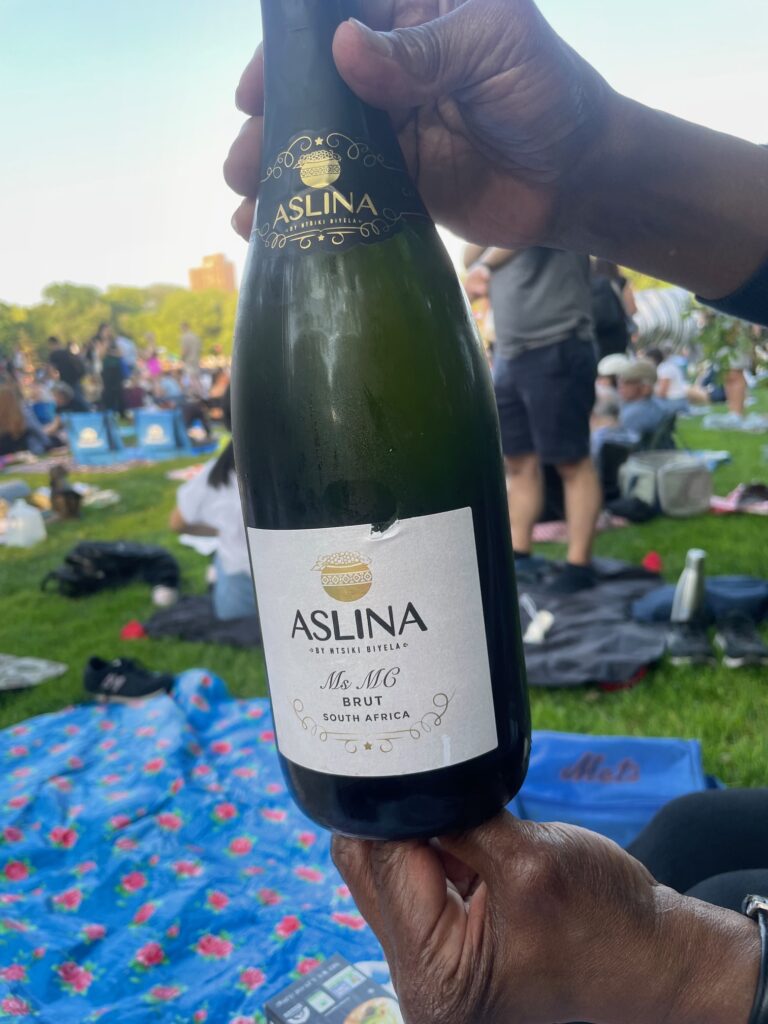
As we listened to selections from Stravinsky’s Firebird Suite, we got back to the Haut-Brion. We kept drinking the wine in tiny sips, while Bernie Williams, the former Yankee and now an amazing electric guitar player and composer, performed Moving Forward, a stirring piece from his second album, and the concert ended around 10:30, with fireworks. The wine had been open for four hours. It never lost a step. It didn’t soften. It didn’t play hide and seek. It was the same dramatic, absolutely chiseled wine that it was at 6:28.
Over the years, many people have said to us, “I don’t know how to describe wines.” Well, we hear you. This wine was not so much a taste as an experience. We wondered how various experts had done it, so the next day we did some research and were amused to see their euphoric characterizations:
Parker: “It is a tour de force in winemaking.”
Jane Anson: “It blew us all away.”
Jeb Dunnuck: “Out of this world and certainly one of the finest wines I’ve ever tasted.”
James Suckling: “This is a wine that makes you dream.”
We’re so glad we didn’t read any of that before we opened the bottle because we probably would have decided to wait—and wait.
Later, the day after the concert, we went back to look at our notes on this wine from when it was released. Here they are: “Beautiful, dense-purple color, with a nose of spices and minerals. Tarragon and sage and densely packed underlying fruit. A wine that holds interest, hiding its charms and making you want to unlock its mysteries. Really fine minerals and acidity. Definitely one for the long run.”
Our notes now could be precisely the same. So: Does this mean we opened it too young? Will this be better in, say, five years? Could it be better? Did we have it at its peak? If not, when would we try it again if we had another bottle? Would it really have tasted much different in five years? We kind of think that the fact that the wine didn’t change with air and time indicates that this is just what it was meant to be – and we would not want it to be any different.
One small lesson we would pass along is that, if you don’t have a nice little wine refrigerator, you should get one. They are widely available and quite affordable these days. We often recommend wine coolers for a simple, everyday reason: You can buy a mixed case of wine (and thus get a discount) and always have a bottle of red or white at a nice temperature. But on top of that, sometimes, just maybe, you will buy a bottle – maybe a pizza red or maybe a first growth – that you simply don’t get around to opening for a while. And when you do, maybe there will be fireworks.
Dorothy J. Gaiter and John Brecher conceived and wrote The Wall Street Journal’s wine column, “Tastings,” from 1998 to 2010. Dorothy and John have been tasting and studying wine since 1973. In 2020, the University of California at Davis added their papers to the Warren Winiarski Wine Writers Collection in its library, which also includes the work of Hugh Johnson and Jancis Robinson. Dottie has had a distinguished career in journalism as a reporter, editor, columnist and editorial writer at The Miami Herald, The New York Times, and at The Journal. John was Page One Editor of The Journal, City Editor of The Miami Herald and a senior editor at Bloomberg News. They are well-known from their books and many television appearances, especially on Martha Stewart’s show, and as the creators of the annual, international “Open That Bottle Night” celebration of wine and friendship. The first bottle they shared was André Cold Duck. They have two daughters.