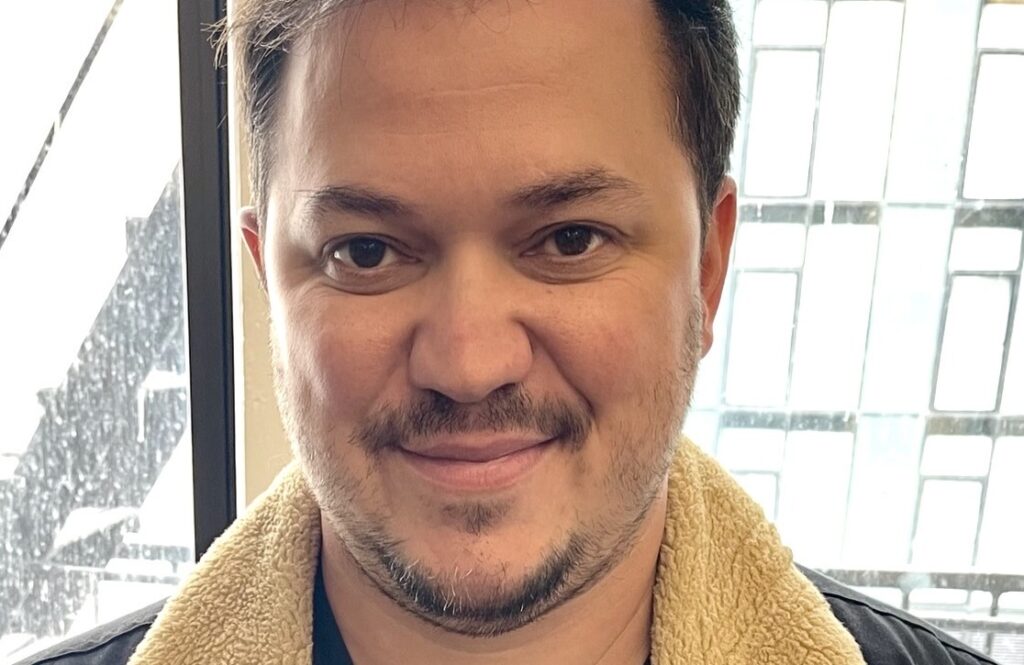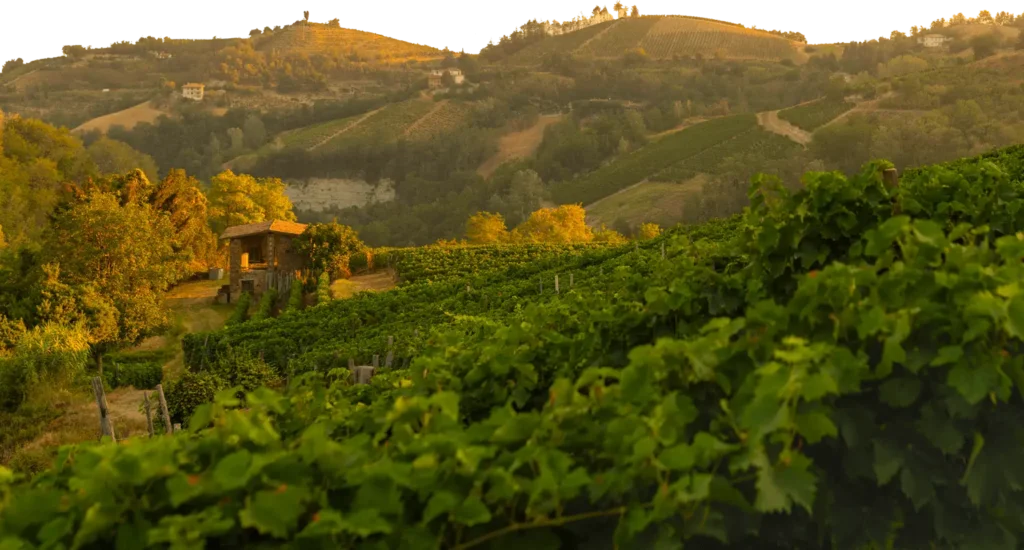
There is a stretch of coastal Croatia an hours drive north of the city of Split where the earth looks less like soil than the aftermath of a geological argument. In the UNESCO-protected area surrounding Primošten, limestone pushed skyward by colliding tectonic plates sits beneath a thin veneer of red clay the iron-rich crvenica, known elsewhere as terra rosa almost no rain for half the year, and yet, planted into this apparent hostility, vines not only survive but produce amazing wines. This is the terroir of Vinas Mora, and Kreso Petrekovic has shuttled between New York City and Primošten to help spread its message.
Petrekovic’s path to winemaking winds through a small Slovenian village, the restaurants of New York City, and a decade-plus career as one of the most respected wine professionals working in the natural wine world. He had been part of his family’s winemaking since childhood, tasting from the age of twelve, traveling through wine regions, and learning from some of the world’s best producers. His first project, Podrum Franjo, proved what was possible when those experiences were brought to bear on Croatian terroir. Then the pandemic came, and Petrekovic found himself at his coastal house in Primošten with time to look more carefully at what was right in front of him.
He had long championed the local farmers who grew Babić with no commercial ambition. It was through that commitment that he found Josipa and Neno Marinov, a local couple farming Babić exactly as their elders had done a century ago. Together with Neno, Petrekovic discovered the nearly abandoned facilities of the local cooperative the place where most of the area’s growers had sold their grapes for generations. Its closure threatened to devastate the entire local wine-growing community. With his friend and fellow wine professional Niko Dukan (who also is the force behind the Karakterre natural wine fair), they stepped in to keep it going. Vinas Mora was born a name that plays on the Croatian word for sea, more, because these vineyards sit only meters above the Adriatic, their Babić vines growing literally in the rocks.
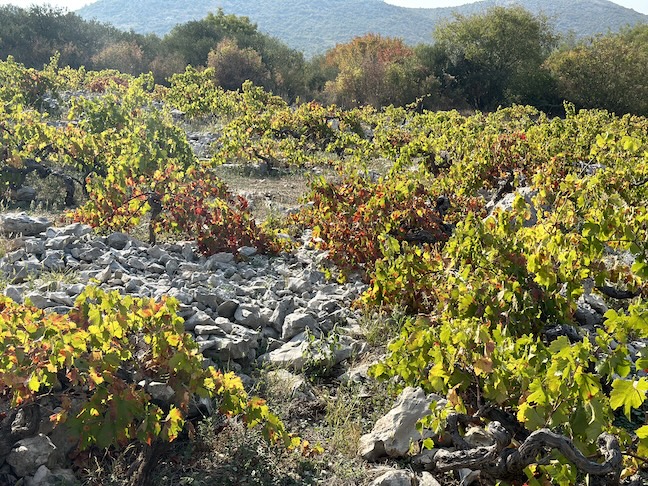
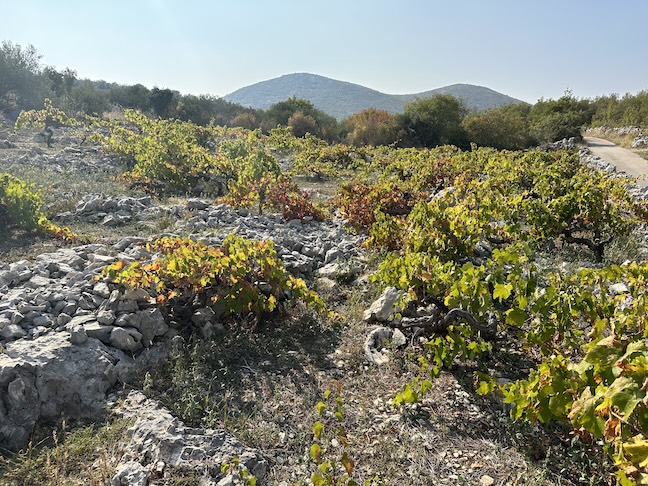
The landscape they work in is magnificent. The tiny enclosed parcels, surrounded by dry-stone walls, hold only three or four plants each too steep, too rocky, too inaccessible for any machinery. Every action is by hand. The crvenica soil, formed by the slow dissolution of limestone and dolomite, is dense and hard with little organic matter, but its clay component holds just enough moisture to keep vines alive through the long, hot Mediterranean summers.
The grape at the center of it all is Babić, leaner and more precise than the better-known Dalmatian grape Plavac Mali, and driven by natural acidity. Vinas Mora also works with other indigenous varieties: whites Debit and Marastina, and reds Plavina and Lasin. But it is Babić that come from the oldest vines and represent the winery’s ultimate ambition to show the world that this small, ancient, rocky corner of Croatia deserves a place among the great wine terroirs of Europe.
Below is our conversation with Kreso Petrekovic. Parts of this interview are included in our award winning short film, Vines in the Shadow of Tito which we hope to release in 2026.
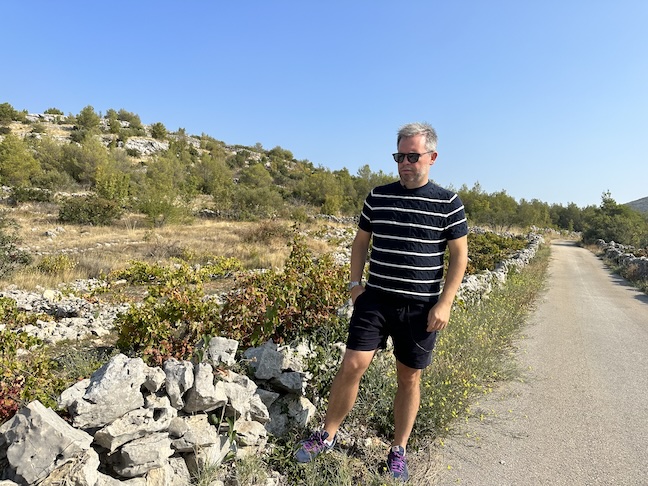
On Terroir
The terroir here is quite unique. As you can see, it’s basically a pile of rocks very dense limestone created by a collision of tectonic plates millions of years ago. That collision formed a kind of super-zone of rocky soil within about a 15-kilometer radius. There’s very little topsoil, which is mainly red clay.
The varietal that fits this territory is Babić. It was planted here because it showed it could survive these conditions and more than survive. Babić actually produces mediocre results in more fertile soil. It really found its way to create quality precisely in this very poor environment.
We sometimes go almost six or seven months without rainfall. The soil depends heavily on underground canals fed by snowmelt from the mountains, which creates an almost year-round water supply. But when very dry and warm conditions hit, that dries out too. We really felt the consequences in the 2021 vintage.
And yet the nature here is grateful for very little. In 2022, some rainfall passed through this specific zone, the clouds moved just over this area. Being a bit cooler here, the old vines survived and produced a yield that doubled compared to the year before. It created truly tremendous results. Nature, like I said, is grateful for whatever you can give her.
These vineyards you see here are grown in a very specific way that we call vlacica, these small enclosed micro-parcels. If you think of Burgundy, where people understand enclosed vineyards, there you might have a parcel of a hectare or half a hectare. Here you have a few square meters enclosed. This larger piece you see is forming a small, unique parcel that protects the vines from wind and keeps what little topsoil there is from blowing away.
These are all bush vines, and we try to shade the soil as much as possible because of the heat. It was the traditional system of growing here. It took a full generation to develop, one generation would go in, remove the rocks by hand, bring back what little soil they could find, and the next generation could work the land. The rocks that were removed formed these walls, which we call suhozid. They separate each parcel and protect against wind. It’s a very traditional way of working throughout Dalmatia, with olives, with vines. It is extremely hard work.
Whoever tried to modernize these practices essentially failed. It’s very difficult to introduce a modern growing system here. Some people had ideas to do things the plantation style, but there is so little water that it’s simply impossible. The vines are planted sporadically, and the old people knew best where there would be water, that’s where vines were planted. Not every parcel works. You can’t just plant on the other side of the hill and expect results. You really have to learn from the old people rather than from any technical or scientific approach developed in the last fifty or sixty years. It’s truly a word-of-mouth kind of knowledge.
On Babić
Babić comes from the same family as some other varieties, though its exact parentage hasn’t been fully determined. It’s a modification of that family, and although there are DNA similarities, it produces a very different wine. It’s more acid-driven, with a more elegant character. I often compare it to the relationship between Cabernet and Pinot Noir, Plavac Mali is the bigger grape in this family, and Babić is the more refined one.
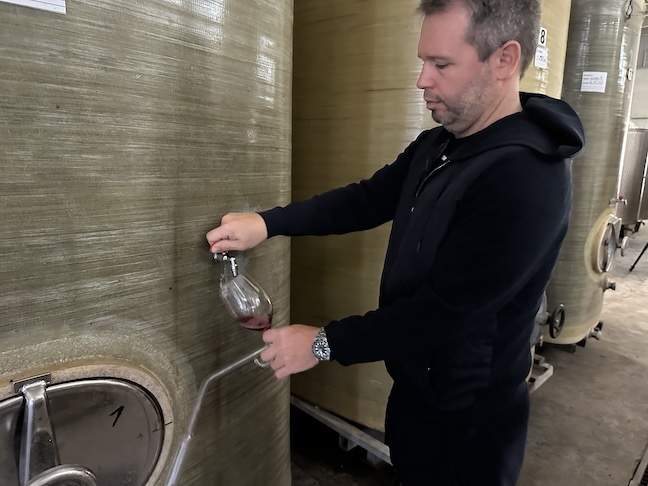
Babić really thrives in this survival-mode environment, producing the naturally low yields you get here. The wines tend to be far less tannic, with natural acidity, extract, and restrained alcohol, rarely exceeding 14% in these conditions. That gives us a really good balance, which makes the work in the cellar much easier. The wines are always very healthy in the cellar because of that balance.
It’s almost an ideal red variety to work with in the style we want, working naturally, not manipulating the wines too much, seeking the expression of the terroir. Babić is a perfect southern varietal for that approach, and a true part of this terroir.
On His Journey to Winemaking
It’s been an interesting journey to arrive at being a winemaker. It started when I was young, dreaming of going to the United States to play music. I really wanted that badly. I hated school, hated the system, I really didn’t want anything to do with ordinary life. I wanted to do something artistic and unique.
So I moved to the States, went briefly to school in Los Angeles, and then moved to New York because some friends were there. I came to New York City for just a week and fell in love with it, I never went back to California after that.
Making a living from music is, of course, extremely difficult. But I’m genuinely glad things unfolded the way they did, because I love this profession deeply. I started working in restaurants, and the wine service in those days was very different. It was hard to get the kind of job I really wanted. Then in 2006 I started working with a small Croatian wine importer. In 2008 I met Zev, who I still work with today. Together we distribute and import wines, and we built an amazing company that has become a meaningful part of the natural wine movement, a portfolio not just of wines, but of people who are now making real careers in wine.
Throughout all of this I was always traveling, always paying close attention. I had made wine with my father as a kid and started tasting seriously when I was about twelve or thirteen years old. I never wanted to do anything halfway. Whatever I grabbed hold of, I went into depth with, and wine was no different.
It’s also a world full of amazing characters, from the producers themselves to the people who visit. It reminded me of show business, honestly. You’re still distributing your art through people who love it.
My father had started to retire, and I thought we could do something together. We started in 2016, made a small amount of wine, sold it, and the response was remarkable, people loved it. By 2020 I was thinking seriously about expanding into continental Croatia, where there was real opportunity in a unique terroir, the rolling hills that extend from Slovenia and Styria.
Then the pandemic hit, and I came here (Primošten). Part of my family is from this region, and I had been coming since I was a child. I connected with a local winemaker and we began seriously discussing how to map the terroir here, how to get people back onto the land. We had gone from 200 hectares under vine to just 20 over the previous twenty to thirty years, and we needed to think about how to build a successful model.
He asked for my help and, somehow, it ended up being me who took it forward. I partnered with Nico and another partner, and we started Vinas Mora, initially just a small winery to see what could be made here. Then that year the main local cooperative went out of business, and suddenly we had a tremendous opportunity to work with truly top-quality grapes. That’s how this really began. I was pushed into an opportunity I’d always dreamed of but never expected to arrive this quickly.
When I go around tasting wines, I’m not looking for technique. What I’m always looking for is substance, that quality in a wine that tells you a place exists. This region always had it. Even when a neighbor was making it in their garage from this material, you could taste how good it was. We took a few steps to elevate the expression of that substance. We hit the right note, and people recognized it quickly. Our first vintage, 2020, sold to 25 countries and landed on some of the best wine lists and with some of the best distributors in the world. It was a real success. Now we’re on our third vintage, which is also powerful and elegant.
On the History of Croatian Wine
Croatia has a very long and remarkable history with wine, and also a very particular recent history that makes it unique.
The Romans, the Greeks, they prized this land for wine. Emperors settled here, partly for the wine, partly for the extraordinary quality of life. The cultivation of grapes here goes back as far as you can trace. And no mystery why: the formation of the Alps and the surrounding mountain ranges, the Adriatic Sea, the temperature differences, the collision of tectonic plates, it all created a super-terroir. If the French had it, they would love it. Anyone would want to work here.
But because of the (Yugoslavia) political system that lasted for fifty or sixty years after the war, making anything of quality was almost impossible. You could only produce mediocrity. It was a uniformly conventional style imposed on everything. And yet, before all of that, during the Austro-Hungarian era, Croatia had a much more dynamic winemaking culture. People were planting the right varietals in the right places, moving in the direction the French had gone years earlier. That legacy, thankfully, was not entirely lost.
After the political changes of the 1990s, people began returning to the land and reopening wineries, or at least getting their land back. But a lot was already lost. Private landowners had built weekend houses on plots that should have been designated as Grand Cru-level sites. Top quality producing areas became tourist zones or just made wine for the household.
Things are changing now. Vines are being planted again. There are more producers. But very few are making wine for export, and very few are working at a truly artisanal level. And there’s an important distinction: making wine for your own consumption in your own country is different from making wine in the style the world drinks. At home you can think you’re the best. But when you step into the big league, that becomes a different story. I was lucky to learn from the best and to be peers with those people. I know what needs to be done.
There is a lot of competition in wine today, and I sincerely encourage my colleagues to work differently. Will there be competition for us? Absolutely, and I applaud every effort. I’m always willing to help. We’ve even started a company to help other producers sell their wines internationally, and we’ve worked together with several winemakers to help them reshape what they were making. Almost a small portfolio. And the results have been tremendous.
The direction for Croatia has to be toward artisanal, boutique production, wines with the imprint of terroir, competing with the great wines of France, not with inexpensive conventional wines from large producing countries. We are a small country where everything in our zone is made by hand. We cannot compete on price. We have to make only really, really good wine — and sell it at proper prices that give people a reason to come back to the land and make a living here.
That is the core problem: people are leaving. The land is being abandoned. It’s been done in the most tragic way, losing so much so quickly in agriculture. Bringing people back means making this economically viable, and that only works with quality.
On Yugoslavia and Communism
Yugoslavia was a federation of Slavic nations in this part of the world, Slovenia, Croatia, Bosnia and Herzegovina, Serbia, Montenegro, Kosovo, and Macedonia. It was formed after World War Two under President Tito and lasted until 1990, when the war began. I grew up in it. I had a wonderful childhood. Nobody was hungry, nobody had too much, but it had its limitations.
You could not produce anything in a craft way. Everything was uniformly conventional, whether in wine or anything else. If you had talent, if you had something special to show, you were simply given a standardized position in life. And that was that.
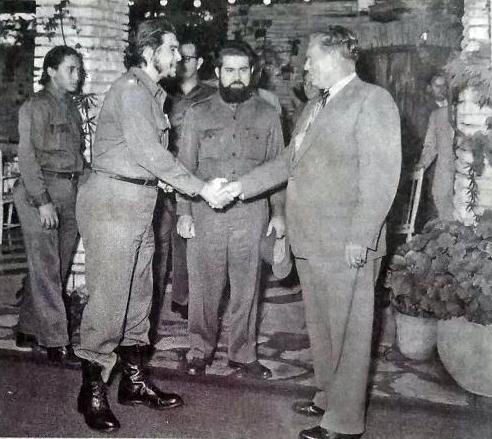
Tito himself was a fighter in World War Two, the leader of the resistance, a genuine hero of the war. He was also the leader of the Non-Aligned Movement, the so-called Third World bloc of countries that stood apart from both superpowers. And he was a remarkable character. He could speak to people at many levels. He went to the US president, the Soviet president, to Africa, to China, and was genuinely respected everywhere. He was extremely charismatic, he surrounded himself with film actresses, had people come to a communist country when that was almost unheard of, wore his famous white uniforms, smoked cigars, drank cognac and whiskey. A real bon vivant. And he loved wine.
But his most significant achievement was blocking Stalin from turning Yugoslavia into a puppet regime. He stepped away from the Stalinist Informbiro, which could have cost him his head. That decision created something different, still a socialist state, but far more open than anything in Eastern Europe. You could travel. Private businesses were gradually permitted. If you went to Poland in the 1980s, the contrast was enormous. Poles coming to Slovenia or Croatia felt like they were visiting America. That was Tito’s doing.
The impact of communism on wine was what it was everywhere, land was effectively confiscated. Any privately owned business producing wine, tobacco, or anything else was taken and handed to the government. At best you could get a job at a state facility. Everything you had, the country now provided, at least in theory.
After the regime fell, people had to fight to prove what had been theirs. Gradually the properties were returned, the vineyards were given back. People returned to the land. But there were exceptions even in the old regime, a few private wineries somehow survived. My theory? Tito loved to drink well. There was a winery next to my village that was producing wine all through that era when no private winery should have existed. He needed someone to make him exceptional wine. And they could.
Everything changed again in the 1990s with the war. And then, after the war, it took a long time, there were no investments, no money. Tourism eventually brought some recovery, though it’s been both a blessing and a curse. It gives a lot, but it also breeds mediocrity. If you can sell everything at your door to visitors, you never feel the pressure to compete at the highest level.
On the War
Like any war, it essentially ends normal life. But this was a particular kind of war, very ethnic, very personal, very dirty. People here struggled enormously. Everyone in this zone went to fight. They were defending against the Yugoslav army, which was one of the most powerful in the world at that time, with all the equipment and the best military resources.
As in any war, though, the aggressor usually loses. When there’s a will, there’s a way. And once the peace agreements finally allowed Croatia to act, it ended very quickly, the liberation operations that cleared the occupied territories concluded in essentially two days. The war could have ended years earlier.
On the Future of Croatian Wine
The future of Croatian wine is to go where the most thoughtful wine regions are going, toward organic, boutique, artisanal production. There are too many large factories and conventional wineries in the world to compete with on their terms.
What we have to do is produce wines with the genuine imprint of terroir, working in a healthy way, whether or not you call it organic or biodynamic, so that the terroir actually comes through in the wine. That’s what people in the world understand. That’s what they’re willing to pay for. And when they pay proper prices, people can come back to the land and make a sustainable living from it.
We’ve demonstrated it with our winery. The wineries working this way sell throughout the world. They are brands that people respect and seek out. They compete with the best. The world is large enough, there are markets everywhere, including places like Russia and China where the competition in winemaking is nonexistent. But you have to produce the wines people actually want to drink, not fill a local supermarket.
I see too many full cellars in Croatia. Too many producers struggling to sell. It comes from not taking those few necessary steps. Look at Bordeaux, the most classical wine region in the world, and they are changing. Becoming organic. Thinking ahead. They are not dogmatic. They want to be better, and they know that means doing things differently and listening to nature.
We are behind. Countries like the Czech Republic and Slovakia have many more producers known internationally than we do. It was once unthinkable that they would be better known in the world than Croatia. We have the land, the terroir, the history. But we make a very small statement in the world of wine. There is a lot to learn from what those countries did, they changed their mentality, learned quickly, and approached it without dogma. Open-minded. That’s the way.