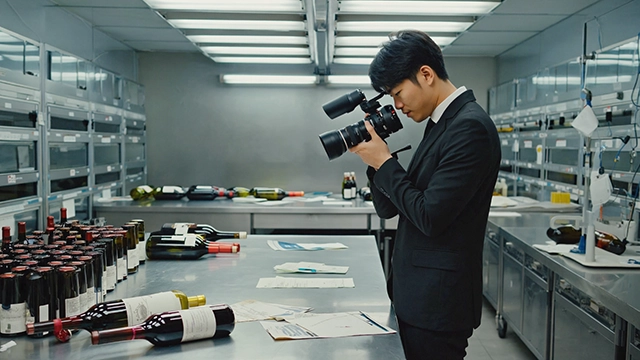
In the shadowy corners of the wine world, where million-dollar bottles change hands in hushed auctions and private cellars, a different kind of vintage has been aging: deception. The history of wine fraud reads like a masterfully crafted thriller, complete with forged documents, elaborate cons, and protagonists whose audacity rivals any fictional criminal mastermind. From ancient Rome to modern-day auction houses, the pursuit of liquid gold has spawned some of the most ingenious and brazen frauds in history.
The Ancient Art of Deception
Wine fraud is as old as wine itself. Ancient Romans were already grappling with counterfeit vintages, with Pliny the Elder documenting cases of merchants mixing inferior wines with prestigious labels. The practice was so common that Roman law specifically addressed wine adulteration, prescribing severe punishments for those caught diluting their products or misrepresenting their origins.
The medieval period saw fraud evolve with trade routes. Merchants would transport cheap local wines in containers previously used for expensive imports, allowing the residual aromas to mask inferior products. Monasteries, ironically, became both victims and perpetrators, with some abbeys accused of selling diluted communion wine to unsuspecting pilgrims.
The Birth of Modern Wine Crime
The 18th and 19th centuries marked the beginning of sophisticated wine fraud as we know it today. The emergence of fine wine as a luxury commodity created unprecedented opportunities for deception. Napoleon’s armies inadvertently contributed to this underground economy when they looted wine cellars across Europe, creating a black market where provenance became increasingly murky.
During this era, the infamous “Bordeaux Scandal” of 1973-1974 shook the wine world to its core. Négociant houses were discovered blending inferior wines with prestigious appellations, selling millions of bottles of fake Bordeaux to unsuspecting consumers worldwide. The scandal revealed how deeply corruption had penetrated the established wine trade, leading to significant reforms in French wine regulation.

Jefferson’s Ghost: The Bottle That Started It All
No discussion of wine fraud would be complete without the legendary Thomas Jefferson bottles and the enigmatic figure behind them: Hardy Rodenstock. A portly German music promoter with a taste for the theatrical, Rodenstock transformed himself into one of the wine world’s most mysterious and controversial figures. His story reads like something from a John le Carré novel—a tale of assumed identities, international intrigue, and the art of the impossible sale.
In 1985, Rodenstock burst onto the fine wine scene with a claim so extraordinary it bordered on fantasy. He announced the discovery of a cache of wine bottles in a bricked-up cellar in Paris, allegedly owned by America’s third president, Thomas Jefferson. The story had all the elements of a perfect wine fairy tale: a mysterious basement, revolutionary-era bottles, and a connection to one of America’s most celebrated founding fathers and documented wine enthusiasts.
Among the discovered bottles was a 1787 Château Lafite Rothschild, its dark glass elegantly engraved with the initials “Th.J.” The bottle’s provenance story was irresistible—Jefferson, while serving as America’s minister to France, had supposedly purchased these wines during his extensive travels through French wine regions. Rodenstock claimed to have documentation proving the bottles’ authenticity, though he remained frustratingly vague about the exact circumstances of their discovery.
The wine world was electrified. When the bottle went up for auction at Christie’s in 1985, it created a media sensation. Bidding was fierce, with collectors recognizing they were potentially purchasing not just wine, but a piece of American history. The hammer fell at $156,000, setting a world record for the most expensive bottle of wine ever sold—a record that would stand for decades.
But Rodenstock was just getting started. Over the following years, he continued to produce Jefferson bottles at a remarkable rate. He claimed to have found entire collections, including bottles of 1784 Château d’Yquem and various Bordeaux vintages, all bearing the telltale “Th.J.” engravings. Each sale commanded astronomical prices, and Rodenstock became a celebrity in wine circles, hosting legendary tastings where the wealthy and powerful gathered to sample what they believed was liquid history.
The German promoter cultivated an air of mystery that only enhanced his reputation. He refused to reveal the exact location of his discoveries, claiming the need to protect his sources. He spoke in riddles about his methods, hinting at connections to French aristocratic families and suggesting he had access to cellars that had been sealed since the Revolution. His theatrical personality—complete with dramatic gestures and cryptic pronouncements—made him a compelling figure in a world that prized exclusivity and insider knowledge.
However, cracks began to appear in Rodenstock’s elaborate fiction. Wine writer Michael Broadbent, who had initially championed the Jefferson bottles, began to harbor doubts. The bottles kept appearing with suspicious regularity for supposedly rare discoveries. More troubling, experts who examined the bottles noticed inconsistencies: the engravings appeared too crisp for bottles allegedly aged in cellars for two centuries, and the glass itself seemed wrong for the 18th century.
The most damning evidence came from an unexpected source: Thomas Jefferson himself. The third president was a meticulous record-keeper, documenting his wine purchases with obsessive detail. Monticello’s curators, along with Jefferson scholars, scoured his extensive correspondence and financial records but found no evidence of the purchases Rodenstock claimed. Jefferson’s wine orders were well-documented, and none matched the bottles appearing at auction.
Investigative journalist Benjamin Wallace’s exhaustive research, documented in his book “The Billionaire’s Vinegar,” revealed the extent of Rodenstock’s deception. Wallace discovered that Rodenstock—whose real name was Meinhard Görke—had a history of questionable business dealings. The mysterious wine discoverer had previously worked as a pop music promoter, managing German bands and organizing concerts. His transformation into a wine expert seemed to coincide suspiciously with the fine wine market’s explosion in the 1980s.
The Jefferson bottle saga became emblematic of a deeper problem plaguing the fine wine market: the willingness of collectors, auction houses, and even experts to suspend disbelief when faced with extraordinary claims. The desire to own something truly unique, combined with the intoxicating possibility of owning a piece of history, created an environment where skepticism was often overwhelmed by wishful thinking.
The Kurniawan Chronicles: A Modern Mastermind
If Hardy Rodenstock was wine fraud’s mysterious phantom, Rudy Kurniawan was its brazen showman—a master counterfeiter whose audacity and technical skill would have impressed even the most accomplished art forgers. Born Zhen Wang Huang in Indonesia, Kurniawan reinvented himself as the ultimate wine insider, a transformation so complete that he fooled some of the most sophisticated palates and experts in the world.
Kurniawan burst onto the American fine wine scene in the early 2000s like a force of nature. Unlike Rodenstock’s shadowy European mystique, Kurniawan was ostentatiously American in his approach—flashy, social, and seemingly possessed of unlimited resources. He quickly became a fixture at high-end wine events, dropping hundreds of thousands of dollars at auctions with the casual ease of someone buying groceries. His Arcadia, California home became legendary for its wine dinners, where he would open bottles worth tens of thousands of dollars as if they were everyday table wine.
What made Kurniawan particularly dangerous was his genuine expertise. Unlike many fraudsters who rely purely on deception, Kurniawan possessed an extraordinary palate and encyclopedic knowledge of wine. He could discuss vintage variations, terroir characteristics, and producer histories with the fluency of a master sommelier. This knowledge made his forgeries devastatingly effective—he didn’t just copy labels, he understood exactly what each wine should taste like and how to approximate those flavors.
From his home laboratory, Kurniawan created what may have been the most sophisticated wine counterfeiting operation in history. His workshop was a marvel of criminal ingenuity: he maintained collections of period-appropriate bottles from every major wine region, libraries of vintage labels that he would painstakingly reproduce, and an arsenal of chemicals and techniques for artificially aging wine. He studied the molecular composition of different vintages, learning to blend cheaper wines in combinations that could fool even expert tasters.
Kurniawan’s masterpiece was his ability to create “ghost wines”—bottles of legendary vintages that had never actually existed. He produced numerous bottles of 1947 Domaine de la Romanée-Conti, one of Burgundy’s most mythical wines, despite the fact that the domain had been replanted after phylloxera and didn’t produce wine under that label until 1952. He fabricated entire collections of impossible Burgundies, creating bottles from producers who had no record of making wine in the years he claimed.
His counterfeit Château Pétrus operation was particularly brazen. Kurniawan produced dozens of bottles of rare Pétrus vintages, using a combination of newer Pétrus blended with other Bordeaux wines to approximate the legendary estate’s profile. He aged the forgeries using techniques that included exposing them to heat, manipulating cork condition, and even using coffee grounds to create the sediment patterns expected in aged wine.
The social aspect of Kurniawan’s operation was crucial to its success. He wasn’t just selling wine; he was selling experiences and relationships. His legendary dinner parties at Cru restaurant in Los Angeles became must-attend events for wine collectors, where he would casually open bottles worth $50,000 or more. These events served multiple purposes: they established his credibility as someone with access to impossible wines, created a network of wealthy potential buyers, and provided cover for introducing his counterfeits into circulation.
Between 2004 and 2012, Kurniawan consigned over $35 million worth of wine to auction houses, with Acker Merrall & Condit alone selling more than $21 million of his consignments. His relationship with these auction houses was symbiotic—they provided legitimacy and market access, while he provided a steady stream of extraordinary bottles that generated tremendous publicity and profits.
Kurniawan’s downfall eventually was related to his own hubris. In 2012, he attempted to consign a collection of supposedly rare Burgundies that included several glaring impossibilities. The collection featured bottles from Domaine Ponsot that included vintages from years when the estate had produced no wine at all. Laurent Ponsot, the domain’s owner, happened to be in New York and examined the bottles personally.
Ponsot discovered bottles purporting to be from Domaine Ponsot’s Clos Saint-Denis Grand Cru with vintages dating back to 1945, when the domaine only began producing wine from that vineyard in 1982. Other impossible vintages, like a 1929 Ponsot Clos de la Roche (domaine started bottling under its own label in 1934), were also part of the consignment. His outrage at finding wines bearing his family’s name from non-existent vintages led to a lawsuit that would help to unravel Kurniawan’s entire operation.
Billionaire collector Bill Koch had already filed a lawsuit against Kurniawan in 2009, alleging he knowingly sold fake bottles. However, Ponsot’s direct intervention at the auction and his subsequent detailed investigation and cooperation with the FBI provided crucial evidence that directly led to Kurniawan’s arrest and conviction for mail fraud and wire fraud. Ponsot’s testimony was a highlight of the landmark trial.
The FBI arrested Kurniawan in March 2012. The FBI raid on Kurniawan’s home revealed the full extent of his counterfeiting empire. Investigators discovered thousands of labels, stamps, and seals from wineries around the world, along with chemicals for artificially aging wine and equipment for manipulating bottles and corks. Most damning was the discovery of partially completed bottles—counterfeits caught in the act of creation.
The book, “In Vino Duplicitas: The Rise and Fall of a Wine Forger Extraordinaire” by Peter Hellman, chronicles in detail the wine fraud perpetrated by Kurniawan.
The Psychology of Wine Fraud
What makes wine fraud so compelling as a thriller narrative is the psychological complexity of both perpetrators and victims. Wine fraud operates at the intersection of art, science, and emotion, exploiting collectors’ desires for exclusivity, status, and connection to history.
The most successful wine fraudsters aren’t just criminals; they’re master storytellers. They understand that expensive wine is never just about taste—it’s about narrative, prestige, and the intoxicating possibility of owning something truly irreplaceable. Hardy Rodenstock didn’t just sell wine; he sold dreams of owning bottles touched by Thomas Jefferson’s hands.
Modern Detection and the Arms Race
Today’s wine fraud has evolved into a high-tech arms race between counterfeiters and investigators. Fraudsters employ sophisticated techniques including radiocarbon dating to verify glass age, chemical analysis to replicate vintage characteristics, and even genetic testing to identify grape varieties and regional characteristics.
Law enforcement has responded with equally advanced methods. The French wine police, officially known as the Central Office for the Suppression of Fraud (OCLAESP), employ teams of scientists and investigators who use everything from mass spectrometry to blockchain technology to verify authenticity. Private authentication services have emerged, offering services that would have seemed like science fiction just decades ago.
The cat-and-mouse game continues to evolve. As detection methods improve, so do counterfeiting techniques. Some modern fraudsters have moved beyond simple label switching to sophisticated operations that can fool even expert palates and scientific analysis.
The Economics of Deception
The financial stakes in wine fraud have grown exponentially with the fine wine market’s expansion. Conservative estimates suggest that counterfeit wine represents a multi-billion-dollar global industry, though the secretive nature of the trade makes precise figures impossible to determine.
The rise of emerging markets, particularly in Asia, has created new opportunities for fraud. Wealthy collectors in these regions often lack the traditional networks and knowledge that might help detect fakes, making them attractive targets for sophisticated operations.
Insurance companies have taken notice, with some major underwriters now requiring extensive authentication before covering high-value wine collections. The emergence of wine investment funds has further complicated the landscape, as institutional investors demand levels of verification that were previously unknown in the genteel world of wine collecting.
“The general consensus over the last half decade is that fraudulent wine accounts for about 20% of the total wine market, or $67.9 Billion in 2020.” – Jane Anson – Inside Bordeaux
The Future of Wine Fraud
As the wine world grapples with its fraudulent past, new technologies promise both solutions and complications. Blockchain verification systems offer the possibility of tamper-proof provenance tracking, while advanced authentication techniques make counterfeiting increasingly difficult.
However, technology also creates new opportunities for deception. Deep fake technology could potentially be applied to creating false historical documentation, while sophisticated chemical analysis might allow fraudsters to create increasingly convincing fakes.
The wine fraud saga continues to unfold, with each new case adding chapters to this ongoing thriller. The story reveals fundamental truths about human nature: our desire for authenticity in an increasingly artificial world, the intoxicating power of status and exclusivity, and the eternal dance between those who deceive and those who seek truth.