On a warm June evening in 2025, something meaningful happened in the intimate dining room of Noreetuh, a celebrated Hawaiian restaurant in New York City that is a favorite with wine industry insiders. What began as a carefully curated dinner for wine enthusiasts, media professionals, and industry insiders became a significant milestone for American Riesling—specifically, for the wines of New York’s Finger Lakes region. The “Judgment of New York,” as the evening was billed, was an ambitious blind tasting that brought together sixteen carefully selected Rieslings from the Finger Lakes alongside some of Germany’s most respected producers.
The evening’s results would prove both affirming and illuminating: Finger Lakes Rieslings earned their place among German wines that represent nearly six centuries of winemaking tradition. More importantly, the tasting demonstrated that American Riesling—building on just six decades of serious development since the 1960s—had matured into wines worthy of comparison with the world’s Riesling benchmark.

Echoes of Paris, 1976
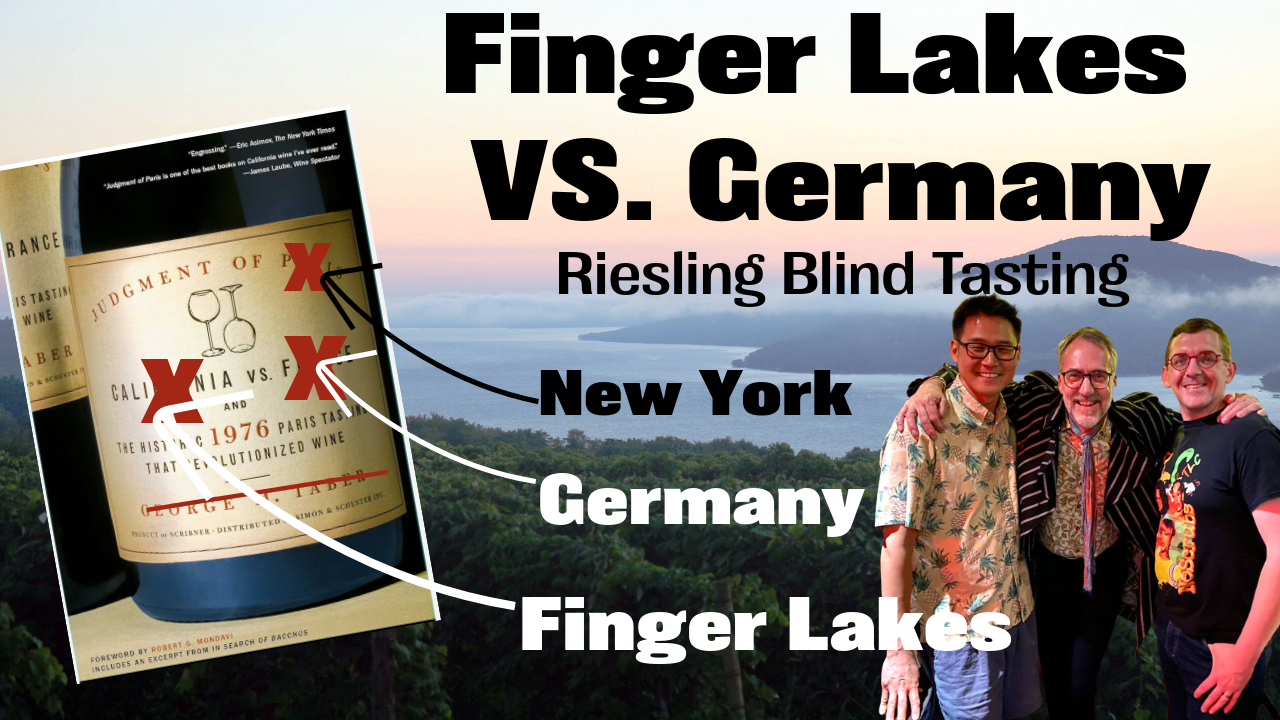
The event’s name deliberately evoked the legendary Judgment of Paris, the 1976 blind tasting that established California wine’s credibility on the international stage. As wine writer Stuart Pigott explained to the assembled guests that evening, “Obviously, this comes from the Judgment of Paris back in 1976. But let me be frank: the Judgment of Paris had a great deal to do with New York City.”
Pigott’s observation highlighted an important parallel. While the 1976 tasting featured a French jury and English organization, “the most important person at that table—whose presence is why we even think about that wine tasting—was George Taber from Time magazine,” Pigott noted. Once again, New York City would serve as the stage for American wines to earn recognition alongside established European benchmarks.
The impact of the original Judgment of Paris was profound and lasting. As Pigott recounted, “On the day of publication, the two winning wines—a Chardonnay from Chateau Montelena and a Cabernet Sauvignon from Stag’s Leap Wine Cellars—sold out coast to coast by the end of the day. One week later, real estate prices in Napa Valley had jumped 30%.”
Perhaps more significantly, the tasting fundamentally shifted how California winemakers viewed their potential. “Suddenly they saw themselves as being in competition with the French,” Pigott explained. “‘Our job is to be the American wine that stands next to the best of France, or exceeds it.’ Winemaking styles changed dramatically.”
Judgement of NY
The Finger Lakes Journey
The Finger Lakes region’s path to this moment represents a remarkable evolution in a relatively short timeframe. While Germany has been crafting Riesling since the grape’s first documented appearance in 1435—nearly six centuries of accumulated knowledge and tradition—the Finger Lakes serious Riesling journey began in earnest during the 1960s. In wine terms, sixty years represents barely two generations of winemaking experience compared to Germany’s centuries of expertise.
As Kelby James Russell, co-winemaker and co-owner of Apollo’s Praise, acknowledged in his opening remarks, the region has long struggled for the consistent critical attention it deserves. “The Finger Lakes very often gets picked up by the newest reviewer at a magazine—someone who’s trying to work their way up. Then they immediately get promoted beyond us if they do well. As a result, the Finger Lakes often doesn’t have someone who takes the history and the terroir seriously.”
The scale comparison Russell shared provided important context for understanding the region’s position. “There is notably more Cabernet Sauvignon planted in Germany than there is Riesling in all of the Finger Lakes,” he revealed. “The Finger Lakes is a tiny region, and you’d have to be a dedicated person to want to make wine there. But hopefully the results show that dedication can yield remarkable outcomes.”
The evening was thoughtfully organized by Jin Ahn, general manager of Noreetuh, along with Russell, Pigott and Robert Dentice (aka Soilpimp), a wine professional with deep connections to both German wine and upstate New York.
A Collaborative Vision
What distinguished the Judgment of New York was the respectful, collaborative spirit that guided the evening. Rather than positioning German and American wines as adversaries, the organizers emphasized shared appreciation for Riesling excellence. “I don’t want to say ‘versus’ because that implies a battle between us and German Riesling, which I think is unfair,” Russell explained. “Between myself and the German winemakers that I’m friendly with, we see ourselves as colleagues in the same pursuit—getting more people to drink Riesling and celebrating the differences that make each of our regions truly distinctive.”
Robert Dentice reinforced this philosophy: “I agree with the sentiment that this is not Germany versus the Finger Lakes, because we just want people to be drinking wine, period. Preferably Germanic wines, whether they’re made in the Finger Lakes, made in Germany, or made elsewhere.”
This collaborative approach reflected a maturity in the American wine industry that acknowledged Germany’s historic leadership in Riesling while asserting that excellence could emerge from newer regions willing to learn and innovate within that tradition.
Judgement of NY
The Tasting: Method and Participants
The evening featured sixteen wines served in four flights, evaluated by approximately twenty carefully selected participants, — all paying guests who had invested in being part of this thoughtful evaluation. The guest list included media professionals like Valerie Kathawala from Trink Magazine, wine wholesalers, and serious Riesling enthusiasts.
The wines were served blind, with participants rating each wine on a 100-point scale. To ensure balanced results and minimize outliers, the highest and lowest scores for each wine were discarded before calculating final averages.
The German selection represented the breadth and depth of the country’s Riesling tradition. From the Mosel came Peter Lauer’s Grosses Gewächs Kupp, Falkenstein’s Kabinett from Krettnacher Euchariusberg, Immich-Batterieberg’s Enkircher Batterieberg, Willi Schaefer’s Spätlese from Graacher Himmelreich, and Julian Haart’s Kabinett from Piesporter Goldtröpfchen. The Nahe was represented by Donnhoff’s Grosses Gewächs Hermannshöhle and Emrich-Schönleber’s Grosses Gewächs Halenberg, while Rheinhessen contributed Keller’s prestigious RR bottling.
The Finger Lakes selection showcased the region’s evolving identity, featuring wines from established producers alongside emerging talents. Apollo’s Praise contributed both a Kabinett-style wine and “The Knoll” from Lahoma Vineyard. Other Finger Lakes representatives included Kemmeter’s “San San,” Hillock & Hobbs Dry from their Estate Vineyard, Dr. Konstantin Frank’s “Margrit,” Hermann J. Wiemer’s “Flower Day,” Hosmer’s Upper North Block, and Ravines‘ Limestone Springs.
Affirming Results
When the scores were compiled, the results provided meaningful validation for the Finger Lakes region’s progress. Willi Schaefer’s Mosel Spätlese earned the highest score at 92.93 points, followed by Falkenstein’s Kabinett at 91.64 points—both representing the pinnacle of German Riesling tradition.
Importantly, Hillock & Hobbs Dry Riesling from Seneca Lake earned 90.79 points, securing third place overall and demonstrating that Finger Lakes Riesling could hold its own among Germany’s finest. Dr. Konstantin Frank’s “Margrit” tied for fourth place with Emrich-Schönleber’s Grosses Gewächs at 90.71 points, while Finger Lakes producer Kemmeter’s “San San” earned 90 points.
The results showed that three Finger Lakes wines scored 90 points or higher, with others placing respectably throughout the rankings. Rather than representing an upset, these scores reflected the natural evolution of a region that has steadily improved its understanding of terroir and winemaking over six decades.
The breadth of successful styles was particularly noteworthy. From the precise linearity of Hillock & Hobbs to the elegant expression of Dr. Frank’s “Margrit” and the distinctive character of Kemmeter’s “San San,” the American wines demonstrated a sophistication that honored Riesling tradition while expressing unique regional character.
The Culinary Enhancement
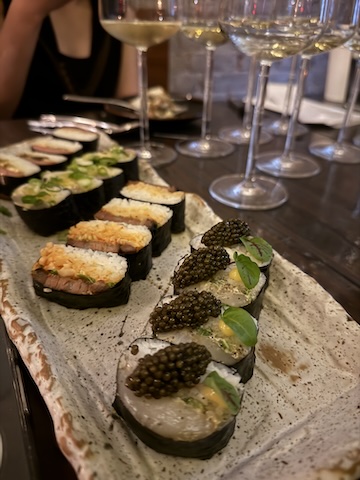
The evening’s success was complemented by Noreetuh’s exceptional Hawaiian cuisine, thoughtfully designed to showcase Riesling’s versatility. The menu featured dishes like tuna poke with seaweed and macadamia nuts, Jersey asparagus with Chinese sausage and Thai basil, and an assortment of musubi including yellowtail with yuzu mayo and Japanese scallop with ossetra caviar. The thoughtful wine and food pairings created an atmosphere of discovery that enhanced appreciation for both the wines and the cuisine.
The restaurant’s intimate setting provided an ideal environment for focused tasting and meaningful conversation. Unlike formal competition environments, Noreetuh offered a convivial atmosphere that encouraged reflection and discussion about what makes great Riesling.
Industry Significance
The implications of the Judgment of New York extend beyond a single evening’s scores to represent broader trends in American winemaking. As Dentice observed, “What they go through there to make wines, and what they’ve endured for the last 25 to 30 years—it’s a really, really tough region. I think they’ve come a long way, and that’s a testament to people like Kelby.”
The tasting validated decades of patient work by Finger Lakes producers who have gradually refined their understanding of their unique terroir and optimal winemaking techniques. It demonstrated that American regions, when given time to develop and mature, can produce wines that earn recognition alongside the world’s established benchmarks.
For the broader wine industry, the results suggest a natural evolution rather than a revolution—the recognition that excellence in winemaking can emerge from dedicated efforts regardless of a region’s relative youth. The Finger Lakes has earned its place in the global Riesling conversation not by displacing German wine, but by adding its own distinctive voice to the dialogue.
A Foundation for the Future
As the evening concluded, participants reflected on witnessing a meaningful moment in American wine development. The competitive framework that had defined the original Judgment of Paris had evolved into something more nuanced—a recognition that great wine emerges from understanding place, tradition, and innovation working in harmony.
Stuart Pigott’s observation proved insightful: “Today’s tasting, I think, is some kind of proof that wines have actually moved several notches up the ladder during recent years. There’s no question about that.”
The Judgment of New York demonstrated that excellence in Riesling is not limited by geography or tradition length, but rather by commitment to understanding what makes each place special. For the Finger Lakes, it was a confirmation of progress rather than a sudden breakthrough—recognition that six decades of dedicated work had yielded wines worthy of comparison with Germany’s centuries-old tradition.
As participants left Noreetuh that evening, they carried with them appreciation for both the German wines that set the standard and the Finger Lakes wines that had earned their place alongside them. The evening’s legacy rests not in dramatic upset or conquest, but in the quiet satisfaction of quality recognized and respected.
Wines Tasted Blind
Peter Lauer, GG, Kupp, Mosel ’23
Kemmeter, San San, Finger Lakes ’16
Hillick & Hobbs Dry, Estate Vineyard, Seneca Lake ’21
Apollo’s Praise, Kabinett, Seneca Lake ’24
Falkenstein, Kabinett #8, Krettnacher Euchariusberg, Mosel ’22
Donnhoff GG, Hermannshohle, Nahe ’23
Immich-Batterieberg, Enkircher Batterieberg, Mosel ’23
Dr. Konstantin Frank, Margrit, Seneca Lake ’24
Willi Schaefer, Spätlese, Graacher Himmelreich, Mosel ’18
Hermann J. Wiemer, Flower Day, Finger Lakes ’24
Hosmer, Upper North Block, Finger Lakes ’23
Julian Haart, Kabinett, Piesporter Goldtröpfchen, Mosel ’23
Keller, Riesling RR, Rheinhessen ’22
Ravines Limestone Springs, Finger Lakes ’22
Apollo’s Praise, The Knoll, Lahoma Vineyard, Seneca Lake ’23
Emrich-Schönleber, GG, Halenberg, Nahe ’23
FINAL SCORES – Top Eight
| WILLI SCHAEFER | 92.93 |
| FALKENSTEIN | 91.64 |
| HILLOCK HOBBS | 90.79 |
| DR FRANK | 90.71 |
| EMRICH | 90.71 |
| KELLER RR | 90.43 |
| KEMMETER | 90 |
| APOLLO’S PRAISE KABINETT | 89.71 |