When it comes to Italy’s great wines, few carry the gravitas that Brunello di Montalcino does. Hailing from a picturesque hilltop town in southern Tuscany, Brunello has long been seen as a benchmark for ageworthy, structured, and noble expressions of Sangiovese. But like many great wines, its identity has evolved, shaped by commercial pressure but, increasingly, a return to its traditional roots.
At the center of this return to tradition is a group of producers dedicated to making wines with restraint, transparency, and a sense of place. One of them is Laura Brunelli, whose estate, Gianni Brunelli Le Chiuse di Sotto, has earned a reputation for classic, elegant Brunello in a region that, for a time, leaned toward a bolder, more modern style.
A Legacy Born in Biondi Santi
Brunello’s story begins in the late 19th century, when Ferruccio Biondi Santi isolated a clone of Sangiovese that he believed was capable of making a long-lived, fine red wine on par with the best of France. His conviction led to the first bottling of Brunello di Montalcino in the 1880s, and by the mid-20th century, Biondi Santi’s Riserva wines had achieved a near-mythical status.
But for much of the 20th century, Brunello remained a niche wine, produced by only a handful of families. It wasn’t until the 1980s and 1990s that Montalcino gained international recognition. With the endorsement of influential wine critics like Robert Parker, the region experienced a surge in investment, production, and stylistic evolution.
To cater to an increasingly global audience, many new producers, as well as some historic estates, began making wines that diverged from Brunello’s traditional profile. These wines were often richer, darker, and oakier from being aged in barriques (small French barrels) rather than the traditional botti grandi (large Slavonian oak casks). The goal was to create more approachable wines in their youth, with greater concentration and polish.
For a time, this strategy worked. Brunello became a favorite among collectors and critics, earning high scores and fetching high prices. But in the process, the line between authenticity and market-driven winemaking blurred.
The Return
Even as modernist styles dominated headlines, some producers, steadfast in their belief that Montalcino’s charm lies in its ability to express place over power, never abandoned the old ways. Others, after flirting with modernization, began to return to tradition, partly in response to climate change, but also due to shifting consumer tastes that have been moving back toward the traditional style. They replaced barriques with botti and are harvesting earlier, embracing transparency over extraction.
Others, like Laura Brunelli, never strayed from the original style in the first place. From the beginning, her wines have reflected a commitment to elegance, restraint, and authenticity. They’re a great example of how subtlety and tradition can still make the most riveting Brunello.
The Soul of Gianni Brunelli Le Chiuse di Sotto
Founded by Gianni Brunelli in the late 1980s, the estate began as a return to his family’s land. After spending years running a successful restaurant in Siena, Gianni returned to Montalcino and reacquired the Le Chiuse di Sotto vineyard, situated just below the town walls, a five-hectare site cultivated with Sangiovese and olive groves.

In the late 1990s, Gianni and Laura expanded the estate with the purchase of Podernovone, a 4.5-hectare property comprising four distinct vineyard parcels. Located on the southeastern slopes of Montalcino at about 500 meters above sea level, Podernovone is planted with Sangiovese and a small amount of Merlot. The altitude, soil composition, and varied exposures added new layers of complexity to their wines.
Since Gianni’s passing in 2008, Laura continues their legacy with conviction. Under her guidance, the estate has maintained its traditional approach while refining it. The Brunello is aged exclusively in large Slavonian oak casks, and fermentation is spontaneous, with minimal intervention. The aim is purity, not polish; transparency, not trend.
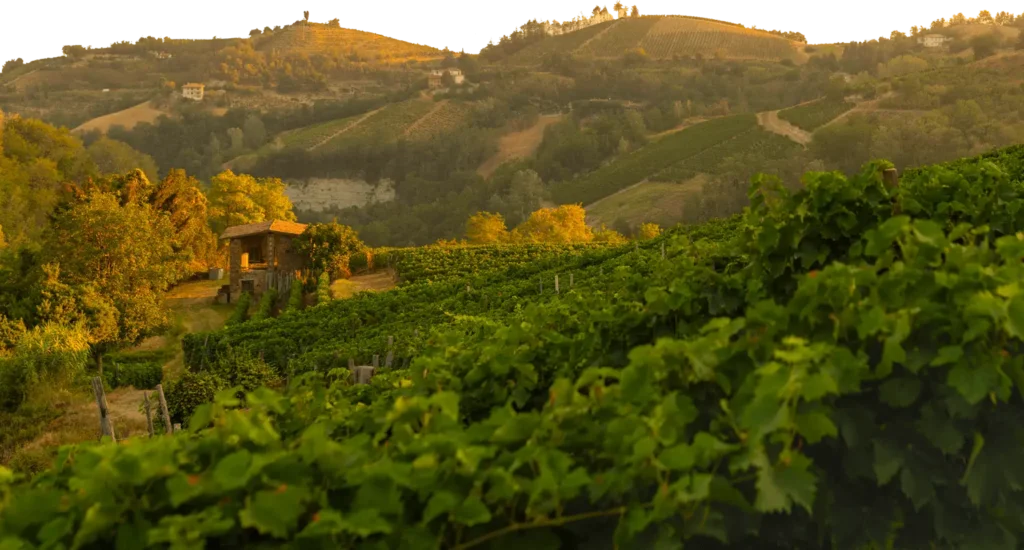
Brunelli’s Brunellos are wines of great finesse, characterized by their fragrant aromas, silky texture, and long, mineral finish. They speak clearly of Montalcino’s southern slope, where the light is intense, the winds are constant, and the soils lend both structure and grace.

In a landscape that sometimes seems divided between stylized power and textbook typicity, Brunelli’s Brunello is a reminder of what made the wine famous in the first place: its ability to age and evolve.
As Brunello di Montalcino continues to navigate its dual identity as a modern appellation and a historic treasure, the voices of producers like Laura Brunelli are more important than ever. Their commitment to tradition is not nostalgia. It’s a forward-looking philosophy grounded in the belief that the past still holds the key to the region’s best future.
Brunelli visited the Grape Collective to share her thoughts on legacy, vineyard work, and her vision for the future of Brunello. Her wines offer a clear vision of what Brunello can be: not the loudest wine in the room, but perhaps the most profound.
Lisa Denning: Can you tell me the history of your winery?
Laura Brunelli: Yes. My winery is in Montalcino. It was originally my husband Gianni’s family estate—his father started it, but the vineyards had been abandoned. In 1987, Gianni decided to return to Montalcino to replant the vineyards and start the winery again. Today, we work with two different vineyard areas in Montalcino, each with its own location and character.
Can you tell me more about the terroir of the two locations?
The two sites have different soils, elevations, and exposures, all of which affect the grapes. One vineyard is Podere le Chiuse di Sotto, located northeast of Montalcino at an elevation of around 200–300 meters above sea level. The soil is mixed, and it’s a cooler area, so the grapes give freshness and more aromatics to the wine. The other vineyard is Podernovone, in the southeast, at about 520 meters elevation. The soil there is rich in galestro stones, broken shale, and gives more minerality to the wine. The altitude and sun exposure are perfect for slow ripening and elegant structure.
What about the Montalcino region overall? Would you say there’s a lot of variation in terroir?
Yes, definitely. Montalcino has many different zones, soils, and exposures. It is so interesting because you have the same grape, Sangiovese, but with different expressions depending on what soil it is grown in.
What’s the difference between the north and south of Montalcino?
My property is in the northeast of Montalcino so it is cooler and the soil, a mixed soil, gives more freshness and aromatics. The southwest is warmer and higher, and the wines have more minerality and structure. The difference in elevation and soil creates very distinct expressions from the same grape.
How would you describe the taste of Brunello to someone who’s never tried it?
For me, the taste of Brunello is all about elegance. In the mouth, it’s very long. I like the minerality, the saltiness. When the pH and acidity are in good balance, it’s very special. That balance is so important.
How has Montalcino changed over time?
Now you see a new generation coming to work at the wineries. At the same time, more investors are arriving, so it’s changing.
Do you feel there’s a tension between locals and outsiders buying land, similar to what’s happening in Barolo?
As long as the newcomers work with respect, I don’t see it as a problem. The key is honoring the land and its history. After that, it’s up to each of us to choose our path.
How did Montalcino evolve into one of Italy’s most prized wine regions?
It’s different—different grapes, different winemaking. I think there are three wines in Italy that are similar in importance: Barolo, Barbaresco, and Brunello. These are historical wines, with strong identity. For Brunello, you need to wait five years after harvest before selling it and that aging process is very important.
Can you tell us about traditional versus modern winemaking. How would you define your style?
My style is traditional because it’s important to have the expression of the terroir and the grapes. In the vineyard, I work to bring in the best grapes possible. In the cellar, I simply guide the natural transformation. I use only big Slavonian oak barrels, no barriques, because I want balance with the content of oak. Sometimes, when I drink the modern kinds of wine, I like it but often it has too much wood taste. I prefer the traditional style because I want the succulence of the grape to speak clearly. The wood is important but with balance.
Would you say there are more traditional or modern winemakers in Montalcino?
In this moment, I think more traditional. Many who used barriques in the past are now going back to big barrels. People are realizing that with large oak, you preserve more of the wine’s character and freshness.
How are you adapting to climate change?
We’ve had to make a lot of changes, especially in the vineyard. You can no longer make a fixed plan at the beginning of the season. You have to adapt to the weather: rain, heat, and everything in between. For example, I no longer remove leaves around the grape clusters. With the sun being stronger now, it’s important to keep some natural shade to protect the fruit. We are always adjusting.
Are you doing anything different in the cellar?
In the cellar, not much has changed. My approach is still natural transformation. But the real work starts in the vineyard. That’s where the biggest adjustments happen.
You also make a small-production wine with Merlot, Amor Castante. Can you tell us about it?
Yes. When my husband planted that vineyard, it was at 520 meters, and we needed a cover crop before planting more Sangiovese. We planted Merlot temporarily, but I liked the expression so much we kept it. The wine is 82% Sangiovese and 18% Merlot. It’s a very particular Merlot because of the soil and elevation. It’s fresher, more mineral, and sometimes people don’t even recognize it as Merlot at first. It’s classified as IGT, so yes, you could say it’s a kind of Super Tuscan.
Do you farm organically?
Yes, completely. I use only natural products in the vineyard, and in the cellar, everything follows natural processes. It’s the only way I believe in working. For me, it is very important to have the respect for what I do. It’s not only because it’s my work, it’s my passion; it’s a love. We also have a responsibility to think about the next generation. We must leave them with a good business, but also something meaningful. A balance of potential and responsibility.