How the author of the Declaration of Independence became America’s first great oenophile and shaped our nation’s wine culture
“Good wine is a necessity of life for me.” Thomas Jefferson
When we think of Thomas Jefferson’s contributions to American history, we typically recall his authorship of the Declaration of Independence, his role as the third President of the United States, the Louisiana Purchase that doubled the nation’s size, his founding of the University of Virginia, his architectural masterpieces, and his championing of individual liberty and democratic ideals.
Yet Jefferson’s legacy is deeply complicated by his ownership of over 600 enslaved people throughout his lifetime, including Sally Hemings, with whom he fathered several children. The wealth that funded his wine pursuits, his architectural achievements, and his refined lifestyle was built on the labor of enslaved people—a profound contradiction that demands acknowledgment even as we examine his cultural contributions. (For more on this aspect of Jefferson’s life, see Smithsonian Magazine’s “The Dark Side of Thomas Jefferson” and Monticello’s comprehensive documentation.)
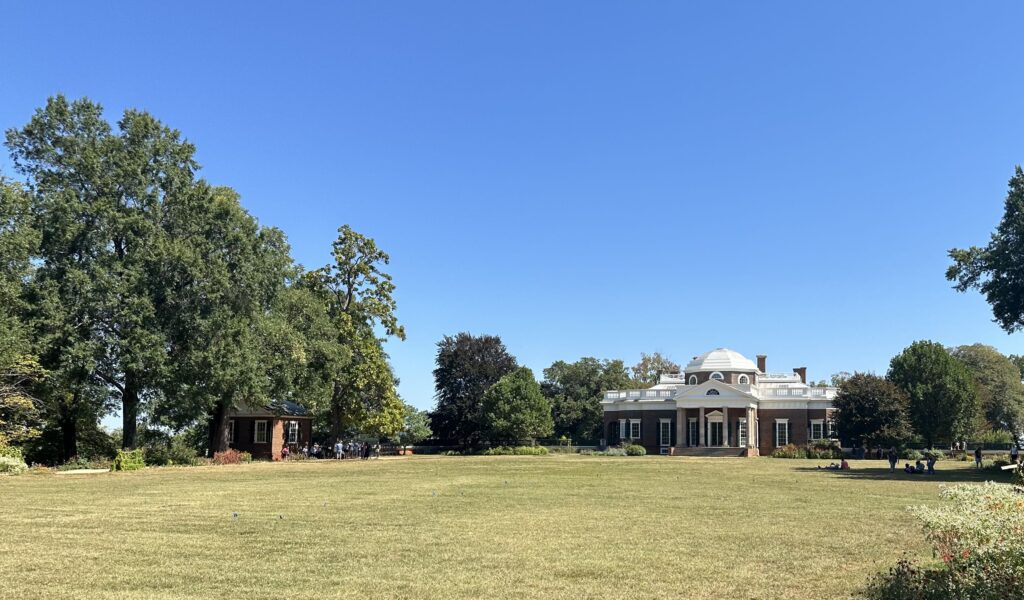
Among his most passionate and personal pursuits—one that would profoundly influence American culture for centuries—was his love affair with wine. Jefferson wasn’t merely a casual wine drinker; he was America’s first serious oenophile, a pioneer who spent fortunes importing the world’s finest wines, planted experimental vineyards across Virginia, and laid the intellectual foundation for what would eventually become a thriving American wine industry. His wine legacy reveals a man who understood that a young republic needed more than good laws—it needed good taste and a culture that could rival Europe’s greatest civilizations.
The Education of a Wine Lover
Jefferson’s journey into wine began during his college years at the College of William & Mary, but it was his five-year diplomatic mission to France (1784-1789) that transformed his casual interest into a passion. As Gabriele Rausse, then Monticello’s Director of Gardens and Grounds and a pioneer in Virginia winemaking, explained in a 2014 interview with Grape Collective: “Jefferson started to drink wine when he was in college, but discovered really wonderful dry wine only when he went to Europe. When he went to France, he discovered Burgundy, Bordeaux. He discovered beautiful wines.”
During his time as Minister to France, Jefferson didn’t simply attend diplomatic dinners and sample wines passively. He embarked on what amounted to a grand tour of Europe’s greatest wine regions, walking through the vineyards of Burgundy and Bordeaux, meeting vignerons, studying viticulture techniques, and tasting wines that would shape his palate and philosophy for the rest of his life.
One particular discovery captivated him completely. As Rausse recounts: “There is one that I particularly love—it’s a wine called Bellet, a very small appellation—and when he went there, he said, ‘This is the best everyday wine ever created in the world!'” This enthusiasm for Bellet, a small wine region near Nice, demonstrates Jefferson’s sophisticated palate and his appreciation for terroir-driven wines that expressed their specific place of origin.
Jefferson’s European wine education went far beyond casual tasting. He studied the relationship between soil, climate, and grape varieties. He observed how different regions produced distinct styles of wine, and he began to envision how these principles might apply to American terroir.
The Philosophy of Wine and Civilization
For Jefferson, wine represented something far more profound than agricultural pursuit or personal pleasure. As historian Geoff Smock writes in the Journal of the American Revolution, “Wine was a metaphor for the positive attributes and institutions of human society that Jefferson zealously believed in, essentially standing for everything that he held to be innately good in humankind.” He believed that wine could transform American society, elevating it from a crude frontier culture dominated by whiskey and hard spirits. In 1818, he declared that “in nothing have the habits of the palate more decisive influence than in our relish of wines,” revealing his belief that taste could shape character and, by extension, democracy itself.
His wine philosophy extended to his role as a public figure. Throughout his presidency (1801-1809), Jefferson served the finest French wines at state dinners, introducing American politicians and foreign diplomats to exceptional Bordeaux, Burgundy, and Champagne. His famous dinner parties typically hosted twelve to fourteen guests seated at a round table, a deliberate choice that eliminated the hierarchy of a traditional rectangular table with a head and foot. At a round table, every guest was equal, embodying Jefferson’s democratic ideals even in the arrangement of furniture. The wine list at these gatherings was impressive, featuring Madeira, Sauternes, Pedro Ximenez Mountain, Montepulciano, and white Hermitage, among many others.
He understood that wine could be a diplomatic tool, helping to establish America’s cultural credentials on the world stage. As Joseph J. Ellis notes, these dinner parties “enhanced the prospects for creating personal bonds and emotional attachments that helped override political disagreements.” Jefferson himself was pleased to witness discussions where “the cloth being removed and wine set on the table” led to remarkably civilized discourse on the most contentious political questions of the day.
Building America’s First Great Wine Cellar
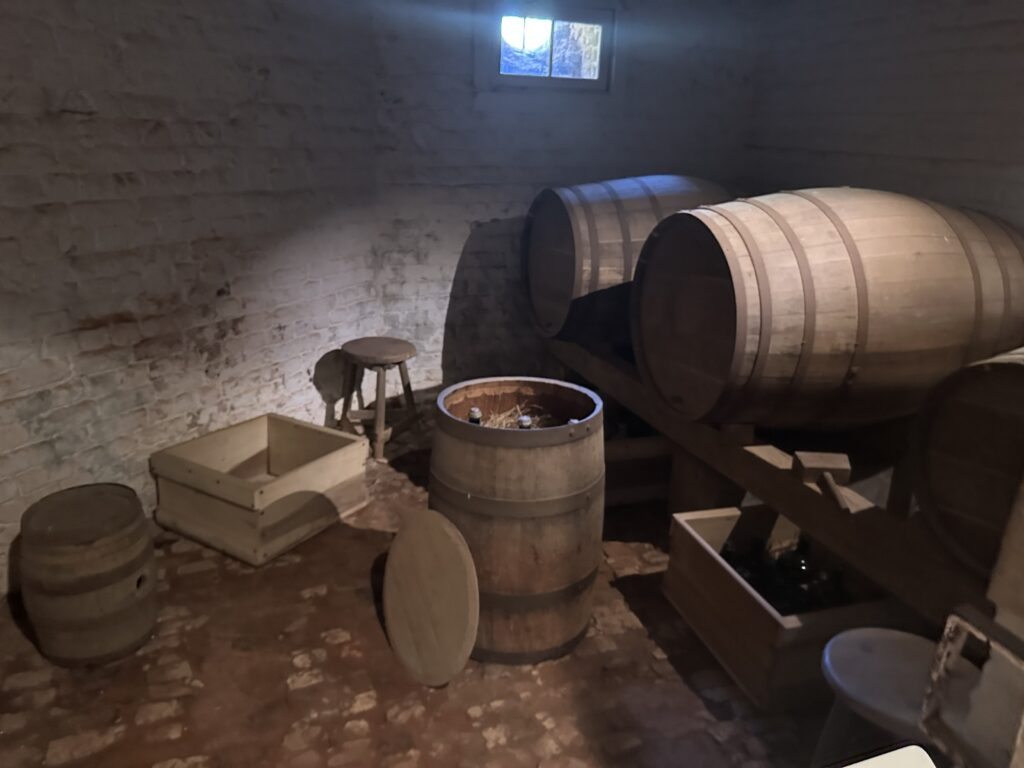
Jefferson’s commitment to wine extended to creating one of America’s first world-class wine cellars beneath Monticello. This wasn’t originally intended as a wine storage facility, as Rausse explains: “This was the first structure built, but it was not built for storing wine—it was built probably to store vegetable roots—but eventually it became the wine cellar.”
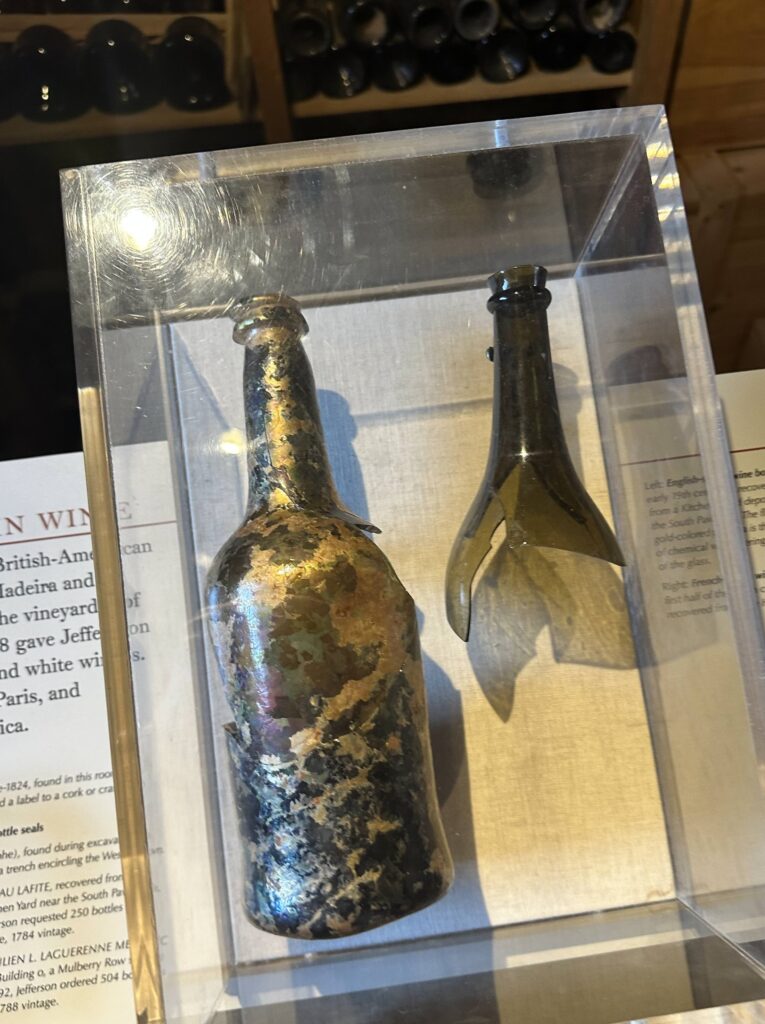
Archaeological evidence reveals Jefferson’s sophisticated understanding of proper wine storage. “An archaeological dig was done and every piece of glass they found was very dark,” notes Rausse. “Jefferson knew where to put the wine—a dark bottle is always better than a light colored bottle, because light can damage the wine.” This attention to detail demonstrates that Jefferson’s wine knowledge went far beyond simply acquiring impressive bottles; he understood the science of preservation.
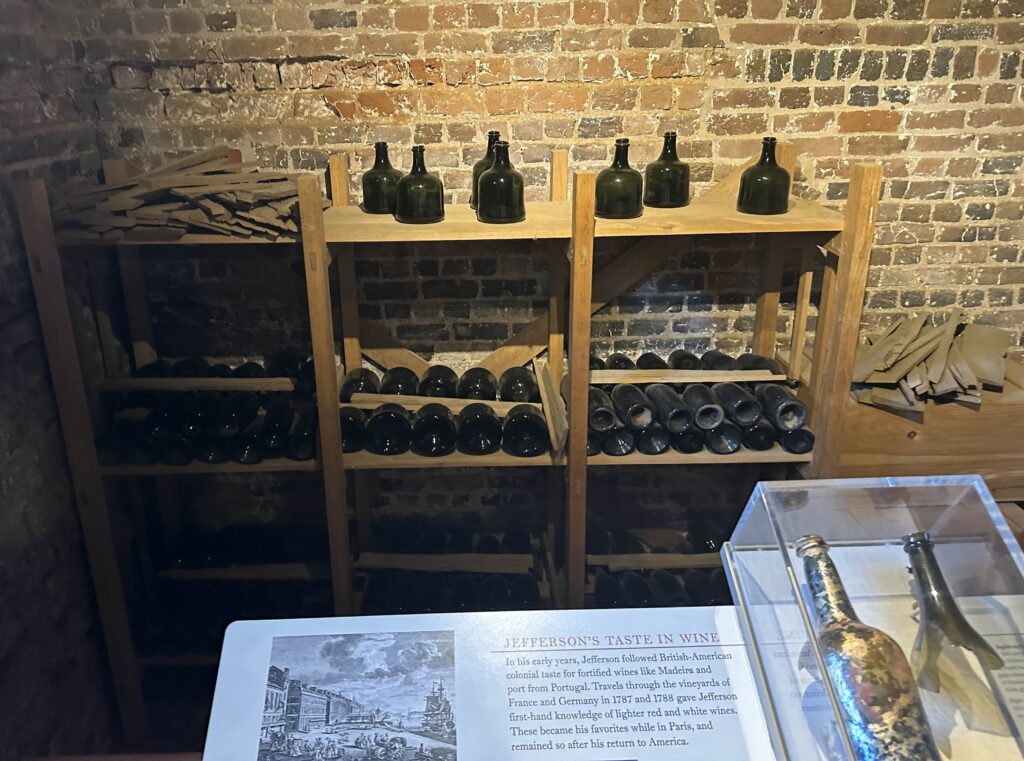
The cellar held an extraordinary collection representing the finest wines of Europe. As Rausse describes: “He had French wine, Portuguese wine, Italian wine, Spanish wine. It depends actually on the finances he had. In the beginning, there was a lot of expensive wine—then he went to less expensive wine.” Jefferson’s meticulous records reveal the impressive scope of his wine program. “During his eight years as president alone, he purchased more than 20,000 bottles of wine—an astonishing quantity that averages out to nearly seven bottles per day, though much was served to guests at his frequent dinner parties. In an article for the International Wine and Food Society, Joseph Temple notes: “During his eight years in office, over 20,000 bottles were purchased from Europe and in less than a fourth-month period, over 200 bottles of Champagne were consumed at 1600 Pennsylvania Avenue.” His ordering practices varied depending on the wine—most orders came in “pipes,” large barrels containing an average of 110 gallons, though he also ordered by the bottle. In November 1804, for instance, he ordered 240 bottles of Hungarian Tokay. At one point his records listed forty different wines from five countries: France (12), Italy (11), Spain (10), Portugal (5), and Hungary (2).
Jefferson’s collection included legendary wines that remain prestigious today. He was particularly devoted to Château Haut-Brion from Bordeaux, which he discovered during his travels and considered one of the four great Bordeaux estates. He adored the sweet wines of Château d’Yquem, describing them with the enthusiasm of a true connoisseur. His love for Hermitage from France’s Rhône Valley was so profound that he often ordered it by the barrel, and he considered the white Hermitage particularly exceptional. The white Burgundies of Montrachet captivated him for their elegance and complexity. He also developed a fondness for Château Margaux, which he served to President Washington and other distinguished guests.
He maintained detailed records of his purchases, creating what amounted to America’s first serious wine journal. His correspondence reveals a man who understood vintage variation, proper serving temperatures, and food pairing principles that wouldn’t become common knowledge for another century. In letters to friends and wine merchants, he would describe with precision the characteristics he sought—the balance of acidity and fruit, the way certain wines complemented specific dishes, the proper cellaring conditions for aging.
The Logistics of Wine Importing
Jefferson’s approach to wine importing evolved with experience and reflected his perfectionist nature. Initially, he imported wine in barrels, but this practice proved problematic. As Rausse explains: “In the beginning he was bringing wine from Europe in barrels. Then he found out that during the trip, somebody may have tasted the wine and done something to the wine. That was the moment he said, ‘No more barrels. I want it to be bottled in Europe.'”
This decision to import only bottled wine was revolutionary for its time and expensive beyond measure. Shipping wine in bottles rather than barrels dramatically increased transportation costs and breakage risks, but Jefferson understood that wine integrity was paramount. He established relationships with European wine merchants and developed sophisticated shipping protocols to ensure his wines arrived in optimal condition, sometimes corresponding for months about a single shipment.
In Wine and the White House A History, Frederick J. Ryan Jr. states that during the presidency Jefferson spent $3,200 annually on wine (about $82,000 in 2025 money). These enormous sums contributed significantly to debts that would haunt him throughout his life and beyond. By the time of his death in 1826, Jefferson owed more than $100,000—a crushing burden that forced the sale of Monticello and nearly all its contents, including whatever remained of his once-magnificent wine cellar. Most tragically, his financial obligations prevented him from freeing most of his enslaved people in his will. Unlike George Washington, who freed his enslaved workers upon his wife’s death, Jefferson’s debts meant that the people who had built his estate, tended his experimental vineyards, and made his refined lifestyle possible remained in bondage even after his death, many sold to pay his creditors.
Critics, including political opponents, accused him of extravagance unbefitting a republican leader. But Jefferson defended his spending as an investment in American cultural development, using his table to teach by example what great wine could be and why it mattered. Yet this rationalization cannot obscure a painful reality: his pursuit of European refinement was financed by enslaved labor.
The Monticello Vineyard Experiment
While Jefferson excelled at importing European wines, his greatest ambition was establishing Virginia as a wine-producing region that could rival the great estates of France. He believed deeply in America’s viticultural potential, writing: “We could in the United States, make as great a variety of wines as are made in Europe: not exactly the same kinds, but doubtless as good.”
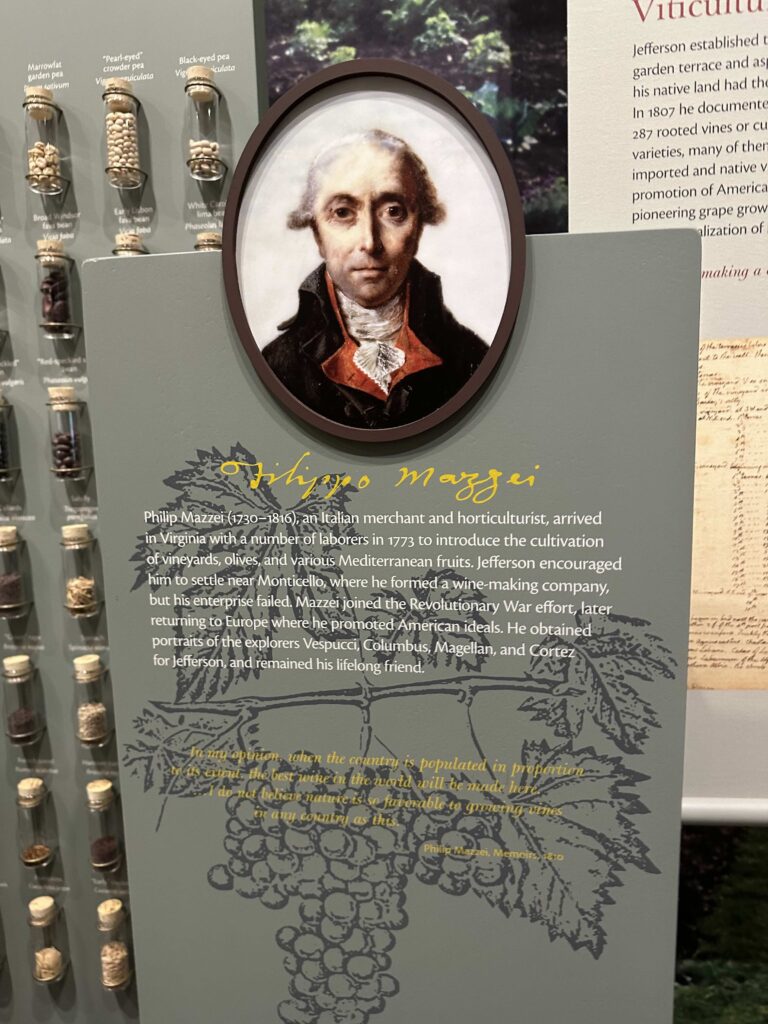
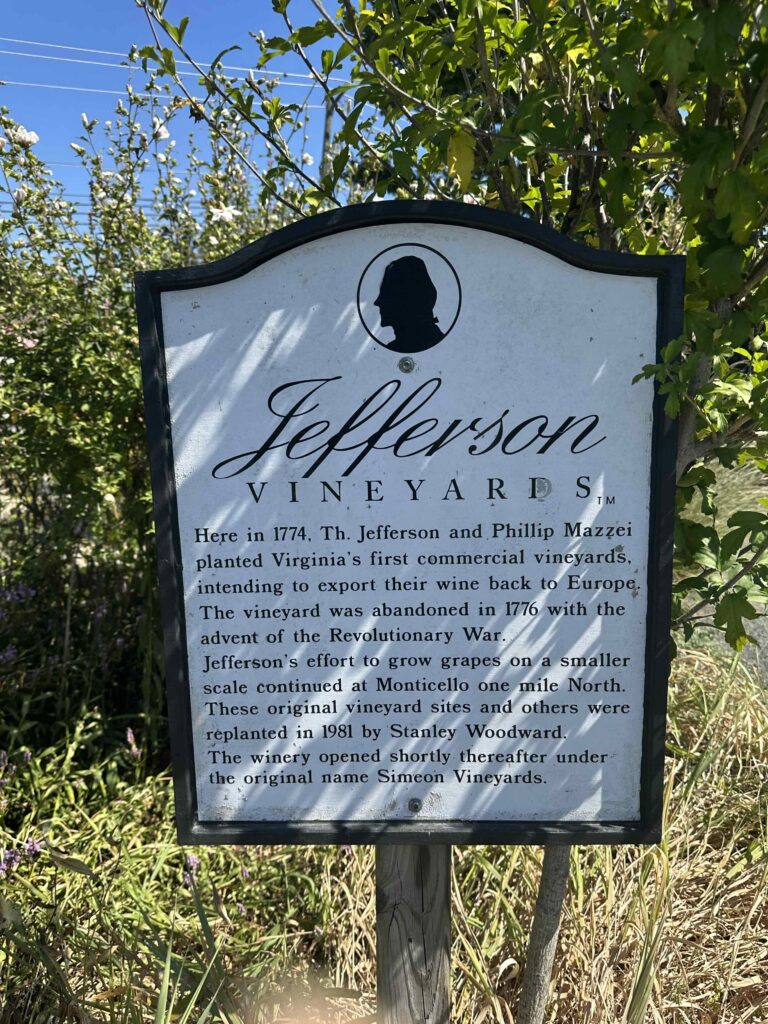
Jefferson’s first significant viticultural venture began even before his presidency. In 1773, Italian viticulturist Filippo Mazzei arrived in Virginia, convinced by Benjamin Franklin and en route to land promised by the Virginia Legislature. Stopping at Monticello, Jefferson persuaded Mazzei to become his neighbor, giving him 193 acres south of Monticello. Mazzei quickly became more than Jefferson’s viticultural partner—he was a trusted friend and political confidant. Jefferson even gave Mazzei a draft copy of the Declaration of Independence, and scholars have noted that Mazzei’s writings on equality may have influenced Jefferson’s famous phrase “all men are created equal.” In 1994, the United States Congress recognized Mazzei’s contributions to the Declaration of Independence.
The following year, Jefferson encouraged Mazzei to form the Virginia Wine Company, which attracted 38 shareholders including George Washington. The company raised a subscription of 2,000 pounds sterling—a substantial sum—for the purpose of raising and making “wine, oil, agruminous plants and silk.”
The partnership faced immediate challenges. A severe frost in 1774 ruined many vines, though Mazzei eventually produced two barrels of wine from six varieties of wild grapes. Despite these early setbacks, Mazzei remained convinced of Virginia’s potential, later writing: “I am of the opinion that when that State [Virginia] is populated in proportion to its area, the best wines in the world will be made there … I do not believe that nature is so favorable to growing vines in any country as this.” Tragedy struck in 1778 when, while Mazzei was abroad on revolutionary business, a Hessian general’s horses trampled the vines at Colle, destroying “the whole labour of three or four years, and thus ended an experiment, which, from every appearance, would in a year or two more have established the practicability of that branch of culture in America.”
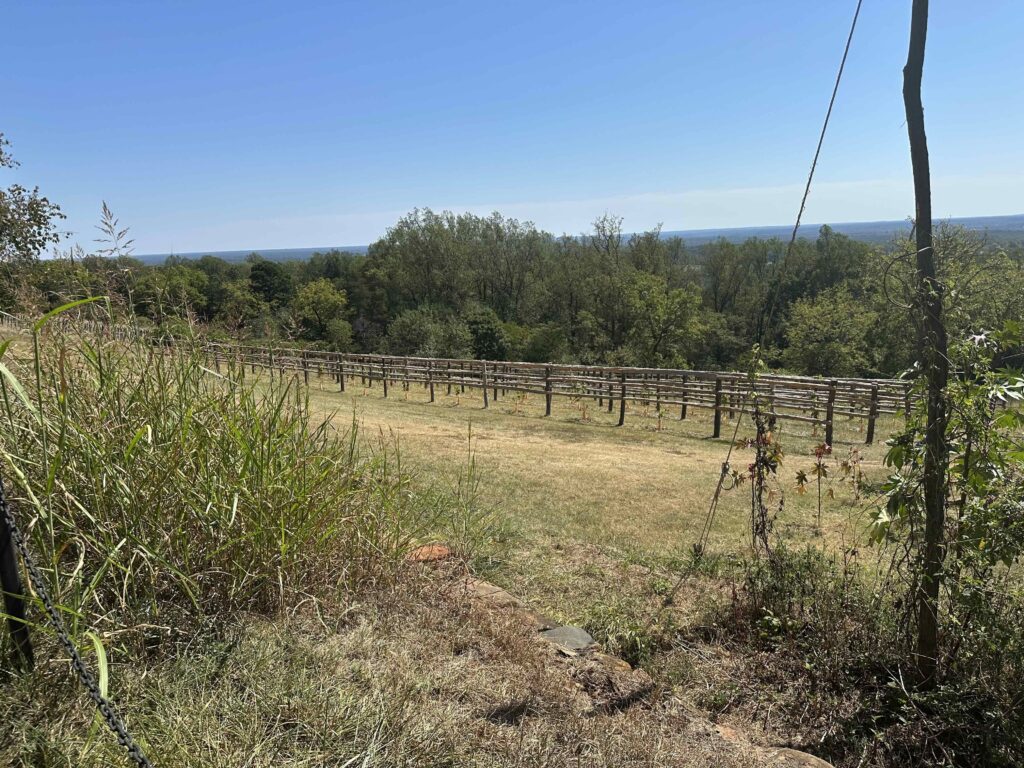
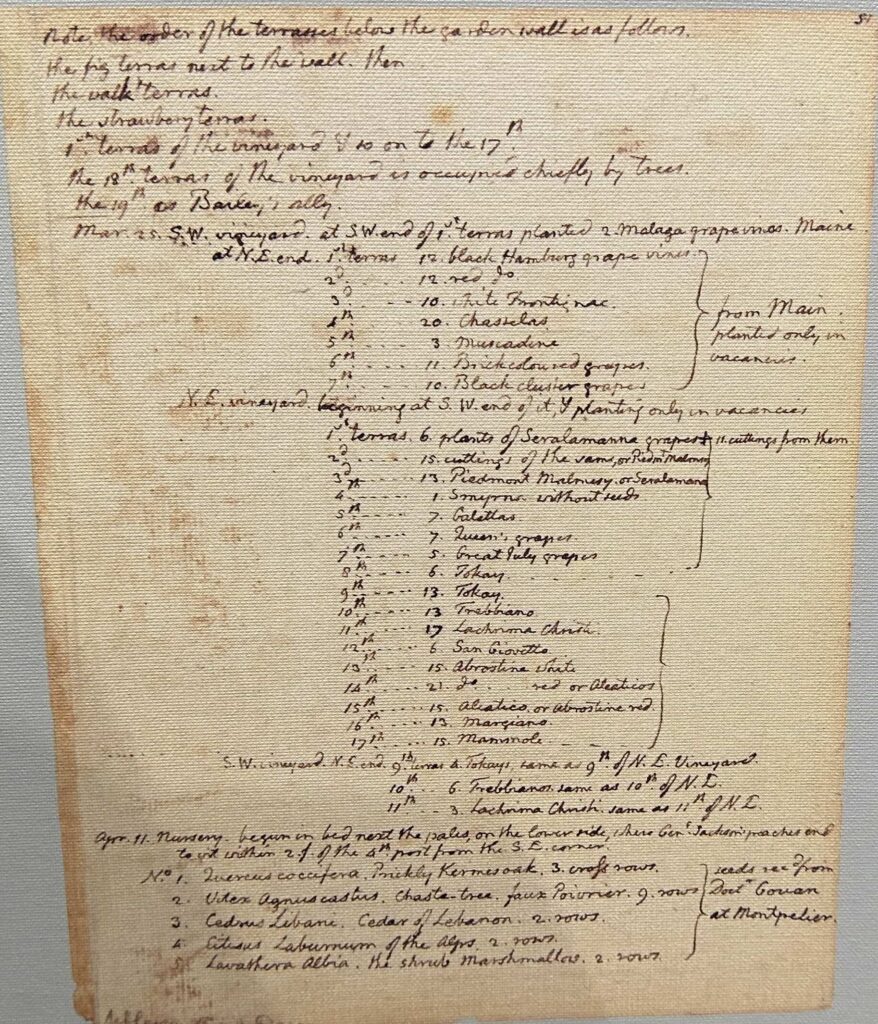
In March 1807, Jefferson planted 287 rooted vines and cuttings of 24 European grape varieties. Where he bought wine by the tens of thousands of bottles to drink and serve, he imported vine cuttings to plant and study.
Jefferson’s varietal selection revealed both sophisticated knowledge and ambitious vision. As Rausse details: “Some were of French origin, and some were of Italian origin: Chardonnay, Chasselas Doré, Chasselas Rosé, Muscat, Muscat Blanc. Italian, the most important are Sangiovese, Toscano, Aleatico—very unusual, but Aleatico was an important variety at that time.”
His choice to plant Aleatico, a rare Italian variety, demonstrates Jefferson’s deep knowledge of European viticulture. Even more ambitious was his experiment with Muscat of Alexandria: “The Muscat of Alexandria, what we call Zibibbo in Italy, is a very unique variety because it’s grown only in the South of Italy and North Africa. But Jefferson planted here and it actually, it’s not doing great, but it’s doing all right,” notes Rausse.
Jefferson approached viticulture with the same scientific methodology he applied to architecture, agriculture, and politics. He documented every planting, every technique, every success and failure in his Garden Book. He corresponded with European experts, seeking advice on pruning, disease prevention, and winemaking techniques.
Despite Jefferson’s knowledge, resources, and determination, his vineyard faced challenges that nineteenth-century viticulture couldn’t overcome. Virginia’s humid climate and native insects proved devastating to European grape varieties. Diseases like phylloxera and Pierce’s disease destroyed vine after vine, turning Jefferson’s wine dreams into expensive failures.
These challenges highlight the differences between winemaking in Jefferson’s era and modern techniques. As Rausse reflects: “I wonder sometimes how they could make wine without any idea what the chemistry was. Today, the first thing you do is an analysis and then you decide what to do. Today, we have very precise numbers. If the pH is 3.9, you know you are in trouble.”
Jefferson and his contemporaries relied on intuition, tradition, and trial and error. “We did not wonder years ago about chemistry. It was just a feeling—’we should do this,’ ‘or you should do that,’ or ‘it’s better to do that rather than that.’ It was really an adventure every time,” Rausse explains. This uncertainty made winemaking far more unpredictable: “Think of the change of the season. If we have a very dry season, it’s not a big deal; the grapes are perfect so you don’t need to make the wine—God made the wine. When you have a difficult year, then it’s a different story.”
Jefferson’s Influence on American Wine Culture
Although Jefferson never produced commercially successful wine at Monticello, his influence on American wine culture proved profound and lasting. He established the template for serious American wine appreciation, demonstrating that New World wine lovers could be as sophisticated as their European counterparts.
Jefferson’s reputation as America’s first great oenophile has endured so powerfully that it even spawned one of the most infamous wine frauds in history. In the 1980s, a bottle purported to be 1787 Château Lafite, engraved with the initials “Th.J.” supposedly indicating Thomas Jefferson’s ownership, sold for $156,000—then a world record for wine. As Benjamin Wallace details in his book The Billionaire’s Vinegar: The Mystery of the World’s Most Expensive Bottle of Wine, this bottle and others allegedly from Jefferson’s cellar were sold by German collector Hardy Rodenstock. The authenticity of these bottles was later questioned, with experts concluding they were likely forgeries. The scandal demonstrated both the extraordinary value placed on Jefferson’s wine legacy and the dangers of that mystique in the hands of unscrupulous dealers. Even in fraud, Jefferson’s name carried enough prestige to command unprecedented prices.
Jefferson’s approach to wine was fundamentally American in its democratic spirit. Unlike European wine culture, which was often exclusionary and class-based, Jefferson promoted wine as a beverage for all citizens. He believed that widespread wine appreciation would make Americans more temperate and thoughtful, replacing the whiskey culture that dominated frontier America.
From Jefferson to the Modern White House
Jefferson’s conviction that wine belonged at the heart of American hospitality did not end with his presidency; it helped shape a White House tradition that has continued for more than two centuries. As Monticello’s historians note, Jefferson not only served wine daily after dinner, but also advised presidents Washington, Adams, Madison, and Monroe on the best wines for executive functions. The whites and reds he favored—from Germany, France, Italy, Spain, Portugal, and Hungary—opened American eyes to the range and quality of European wine and firmly established wine as a fixture of presidential entertaining.
Later presidents and first ladies built on this precedent. Lyndon Johnson invited Robert Mondavi to a state dinner and helped introduce guests to modern Napa wines, while Richard Nixon served California sparkling wines such as the 1969 Schramsberg Blanc de Blancs in historic toasts, during the 1972 dinner with Chinese Premier Zhou Enlai. By the Reagan era, California Zinfandel and Merlot had appeared on the White House table, signaling the maturation of American wine and the realization of Jefferson’s belief that the United States could produce wines to rival Europe’s best.
This tradition has evolved into a deliberate celebration of American winemaking at the highest level of state. In Wine and the White House, former First Lady Michelle Obama is quoted on how this legacy is woven into both everyday and official hospitality: “Since the days of Thomas Jefferson, Americans have used wine as an expression of warmth and hospitality. Whether it’s over a family dinner in a Southside Chicago bungalow or a State Dinner at the White House, wine has a way of sparking curiosity and bringing people together in companionship. While hosting guests at the White House, we tried to be thoughtful about the wine we served—choosing varieties that not only complemented the food courses but also showcased the extraordinary quality of American made wines. It was always a special moment when an honored guest complimented or asked about a particular wine, giving us a chance to lift up the talent of American winemakers, each of whom treat their craft with admirable care and consideration. Both Barack and I look back fondly on evenings spent entertaining in the White House, thanks in no small part to the conversations shared about and over wine.”
The Modern Legacy
Today, Jefferson’s wine vision has finally been realized. Virginia has emerged as one of America’s most dynamic wine regions, with over 300 wineries producing wines that earn international recognition. The climate and disease challenges that defeated Jefferson have been largely overcome through modern viticulture techniques, disease-resistant rootstock, and improved understanding of Virginia terroir.
Remarkably, Jefferson’s original viticultural dream has come full circle on the very land where he and Mazzei first planted vines. In 1981, the Woodward family—who owned the historic Colle property that Mazzei had established—hired Gabriele Rausse to plant Chardonnay, Cabernet Sauvignon, and other varietals on the same 193 acres Jefferson had given to Mazzei. In 1993, honoring Jefferson’s dream of establishing a commercial vineyard on this land, the business was renamed Jefferson Vineyards.
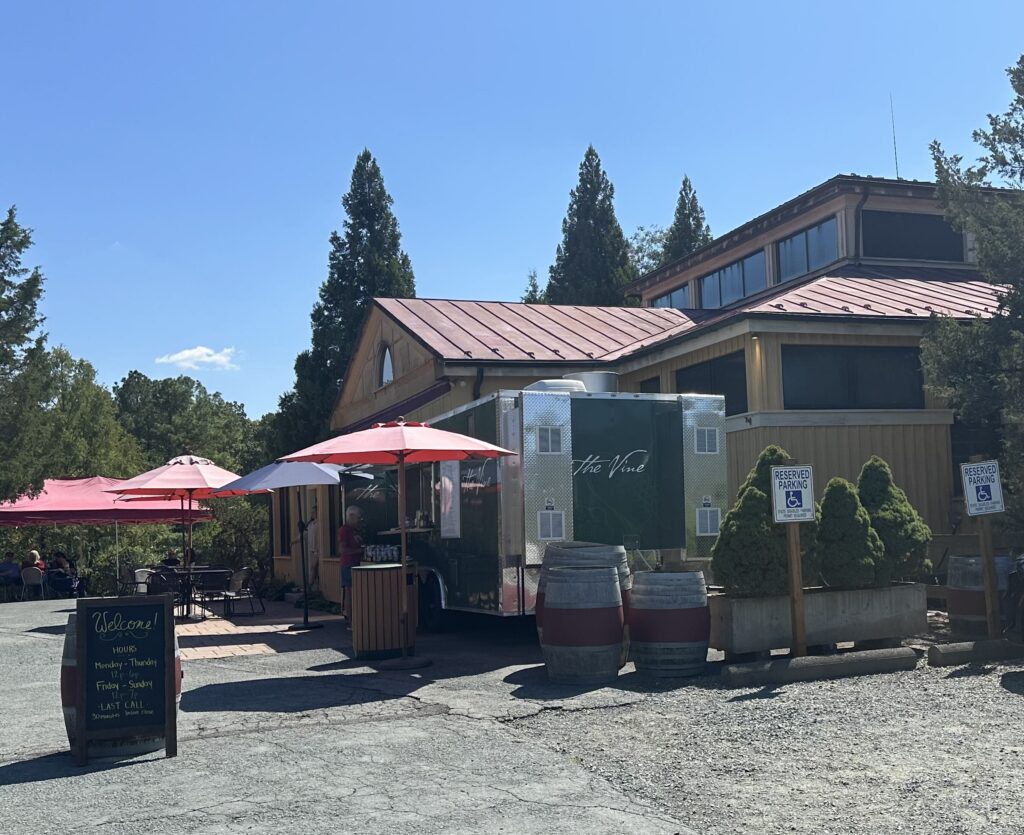
In a historic development, the Thomas Jefferson Foundation, which owns and operates Monticello, acquired Jefferson Vineyards in January 2023. This acquisition directly connects the modern winery with the historic site, allowing for enhanced preservation and education about Jefferson’s viticultural vision. The Foundation’s stewardship ensures that visitors can experience both Jefferson’s architectural masterpiece and the realization of his wine dreams on the very land where he first attempted them.
Barboursville winemaker Luca Paschina puts it in an interview with Grape Collective in 2014, he arrived from Italy in 1990 to find “a very underestimated region,” but one with “great potential,” a challenge he found “meaningful.” He notes that Virginia’s emergence “happened through careful observation, patience, and respect for what the land and climate can offer,” the same long-view Jefferson himself once embraced.
Gabriele Rausse, who spent decades working to restore Jefferson’s vineyard at Monticello during his tenure as Director of Gardens and Grounds and establishing his own winery nearby, represents the continuity between Jefferson’s vision and modern Virginia wine. At his winery about five miles from Monticello, Rausse made twelve different varieties of wine, including some that Jefferson attempted: “I decided to do Nebbiolo because I thought it was an interesting variety to try. In Italy, it’s grown only in Piemonte. In Virginia, I think we can make some very nice Nebbiolo—we have five or six wineries now that make it,” he told Grape Collective in 2014.
Rausse’s approach echoed Jefferson’s experimental spirit: “All my wines, except one, are 100% varietal. I like to see what comes out of the growths, and for that reason I don’t blend much.” This commitment to expressing terroir through single varietals reflected Jefferson’s belief that American wine should be honest and authentic rather than imitative.
The modern Virginia wine industry also fulfills Jefferson’s vision of wine as a democratic pleasure accessible to all. As Rausse observed in 2014: “Virginia agriculture is not very well developed at this point. There are much better places in America to grow crops. Virginia’s climate is not the best, but the grapes are doing all right. The fact that a lot of people come to visit Virginia makes it even more interesting, because they are coming to discover the history around this place, and with a glass of wine, the history looks much more interesting.”
Wine Tourism and Cultural Heritage
Jefferson’s integration of wine with history and culture has created a uniquely American form of wine tourism. Visitors to Monticello don’t simply taste wine—they experience the intersection of American history and viticulture.
The restored vineyard at Monticello, where Rausse replanted many of Jefferson’s original varieties during his years as Director of Gardens and Grounds, serves as both historical recreation and living laboratory. Visitors can walk the same slopes where Jefferson dreamed of American wine excellence, tasting wines made from grapes he planted more than two centuries ago.
The Founding Father of American Wine
Thomas Jefferson never achieved his dream of producing world-class wine at Monticello, but his failure was more productive than most successes. He established the intellectual, cultural, and philosophical foundation for American wine culture, creating a vision that took two centuries to fully realize.
Modern American wine culture, with its emphasis on innovation, accessibility, and democratic values, fulfills Jefferson’s original vision while extending it in ways he couldn’t have imagined. From Napa Valley to the Finger Lakes, from Virginia to Texas, American wineries embody his belief that New World wine could equal and eventually surpass Old World traditions.
Further Reading
For those interested in exploring Jefferson’s wine legacy more deeply, several excellent resources are available:
- Thomas Jefferson and Wine at Monticello – The Thomas Jefferson Foundation’s comprehensive historical documentation and research
- John Hailman’s Thomas Jefferson on Wine (University Press of Mississippi, 2006) – The definitive scholarly work on Jefferson’s wine knowledge and collection
- Frederick J. Ryan Jr.’s Wine and the White House: A History – Detailed documentation of Jefferson’s presidential wine expenditures and entertaining practices
- Benjamin Wallace’s The Billionaire’s Vinegar: The Mystery of the World’s Most Expensive Bottle of Wine (Crown Publishers, 2008) – A fascinating investigation into the fraudulent Jefferson wine bottles sold by Hardy Rodenstock
- Journal of the American Revolution’s “Exploring Thomas Jefferson’s Love of Wine” – An insightful analysis of how wine connected to Jefferson’s broader Enlightenment philosophy
- James M. Gabler’s Passions: The Wines and Travels of Thomas Jefferson (Bacchus Press, 1995) – Detailed documentation of Jefferson’s European wine travels and favorite vintages