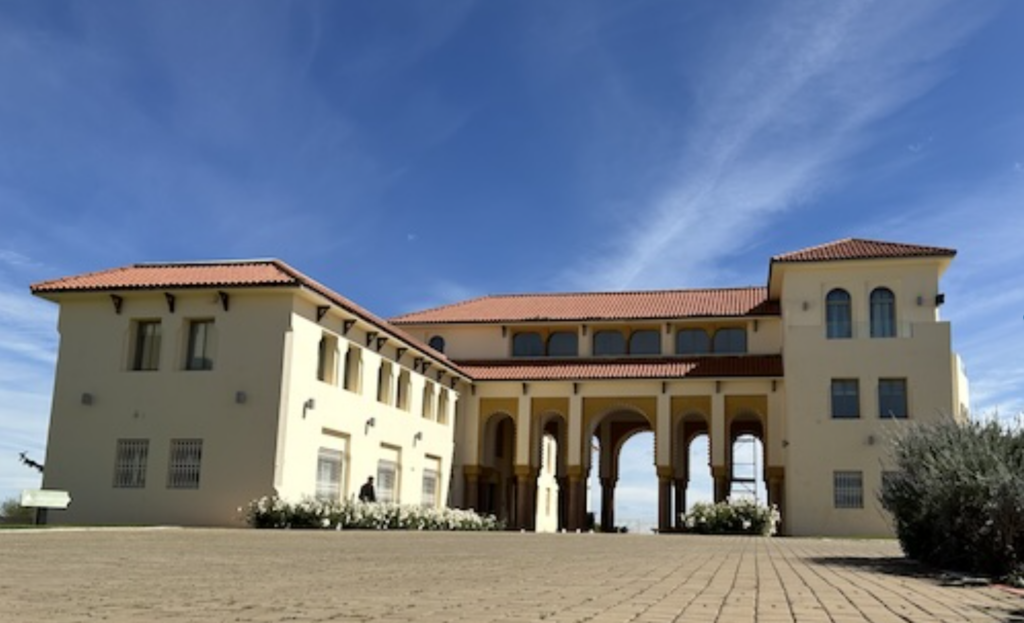
Morocco is a land of contradictions and ancient echoes, a place where the ruins of the Roman city of Volubilis stand as witnesses to a wine history that stretches back millennia. While the world often looks to the Northern Hemisphere for the pillars of winemaking, a quiet but significant revolution is taking place in the foothills of the Atlas Mountains. At the center of this movement is Château Roslane, the first estate in Morocco to be granted AOC status, and its technical director, Guillaume Constant.
Constant’s journey is one of classical training meeting frontier ambition. A veteran of the Bordeaux scene, specifically the prestigious botrytized world of Sauternes at Château Gilette, Constant traded the humid mists of the Ciron for the arid, wind-swept plains of the Meknès region in 2010. After a twelve-year tenure at Domaine de la Zouïna, he joined Château Roslane—the “crown jewel” of the Zniber family’s wine empire, Les Celliers de Meknès.
The story of Château Roslane is inextricably linked to the history of modern Morocco. Founded in 1964 by Brahim Zniber at the end of the French Protectorate, the estate became a bastion for Moroccan viticulture during a period of transition. Today, while Morocco produces only a fraction of the volume it saw in the 1960s, the focus has shifted dramatically from quantity to quality. The “vins médecins” (doctor wines) of the past—high-alcohol, deeply colored blending components used to “fix” thin European vintages—have been replaced by terroir-driven bottles that aim for elegance despite the intensifying Saharan heat.
In this interview with Grape Collective, Constant discusses the delicate balance of winemaking in a Muslim country where consumption remains a cultural taboo yet a commercial reality. He outlines the existential threat posed by climate change, the abandonment of traditional French varieties like Merlot in favor of heat-hardy Mediterranean grapes, and the ongoing quest to define a truly Moroccan identity in the glass. As water becomes the region’s most precious commodity, Constant and his peers are reimagining the vineyard as a resilient ecosystem, proving that the ancient soils of North Africa still have much to say to the modern world.
Grape Collective: Guillaume, tell us about your background and how you ended up in Morocco.
Guillaume Constant: I arrived in Morocco in 2010. Before that, I was in Bordeaux—specifically in Sauternes. I worked for a long time at Château Gilette, which is a lovely estate. I stayed at Domaine de la Zouïna for 12 years after arriving here, and I joined Château Roslane about two and a half years ago.
Can you explain the history of Château Roslane and its role in the Moroccan wine industry?
The estate was created in 1964 by Mr. Zniber. It was established at the end of the Protectorate; when the French left, Mr. Zniber took over quite a few estates and acquired roughly four or five large cellars. He was one of the few Moroccans who wanted to make wine at the time. Initially, many winegrowers grew the grapes and brought them to him for vinification.
Today, this estate represents 80% to 85% of Moroccan wine production. We produce 24 million bottles per year. Until the 1990s, we were essentially the only winery in Morocco. In the ’90s, King Hassan II realized we weren’t producing enough, so he brought in French groups like Castel and Magrez to invest and raise the level of viticulture.
How is the Moroccan wine system structured in terms of quality and designations?
We have AOGs (Guaranteed Designations of Origin) and AOCs. We were the first to create an AOC here in 1998, using the French texts as a model. While the terroir is slightly less strictly delimited than in France for the AOGs, our AOC plots are specifically defined.
We are currently in the Benintir AOG. Just behind the main road is Guerouane. Today, there are three or four AOCs that have been created—Castel has one, as do Domaine de la Zouïna and La Ferme Rouge.
Climate change seems to be a major factor here. How are you adapting in the vineyard?
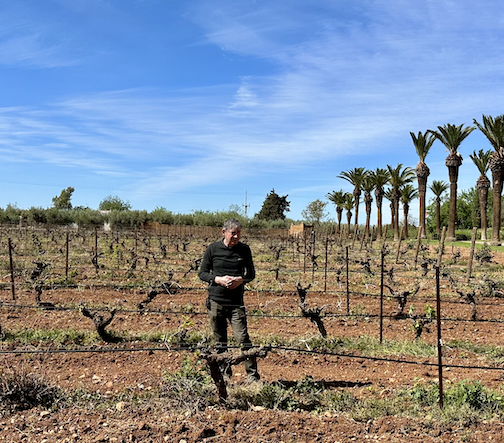
It is getting more and more complicated. We lose roughly 200 hectares of vines per year to abandonment because we can’t irrigate anymore—there is simply no water. To counter this, we are changing how we grow. We are moving toward “greening” the plots, using grassing and hedges to insulate the vines from the extreme heat.
We are also changing our grape varieties. When the French arrived in 1910, they brought their own varieties and the native grapes more or less disappeared. Today, there are no truly indigenous varieties left. We have Carignan, Cinsault, and Grenache from that early period. Syrah does very well here, but we’ve practically stopped growing Merlot because it can’t handle the heat. We are now integrating Malbec, Petit Verdot, Caladoc, and Marselan—varieties from Southern France and Spain that are better suited to our climate.
What is the historical context of these wines? They used to be called “Vins Médecins,” correct?
Yes. Back in the day, Moroccan wines were known as “les vins médecins” (medicine wines). Because we had high alcohol and deep color, our wines were used to “improve” French wines, which at the time had much lower alcohol levels.
That trade stopped in the 1970s when Europe moved away from blended wines and the French left Morocco. Production plummeted. Today, we produce only 10% of what we did in the 1960s. However, the focus has shifted. King Hassan II, who studied in Bordeaux and knew people like Jacques Chaban-Delmas, wanted to raise the quality of what was being made here.
How does winemaking function within a Muslim society? Is there a local market?
It’s a bit difficult to speak openly about “consumption.” Officially, you can’t say Moroccans drink wine because they are Muslim, and alcohol is not permitted. There is certainly a taboo, and much of the consumption is hidden or “under the radar.” But the reality is that there is significant domestic consumption in Morocco. Because it is a Muslim country, the King preferred to have wine produced domestically rather than importing it.
What is the future for Château Roslane and Moroccan wine in general?
Despite the challenges with water and heat, Moroccan wines are moving upmarket. We have one organic estate now, and while the rest isn’t certified, the lack of rain means we rarely have to treat the vines anyway. We are focused on quality and adapting our viticulture to survive the changing environment.