Schiava, the ancient red grape of Alto Adige in northeastern Italy, has spent decades absorbing criticism. As recently as 2002, Joseph Bastianich and David Lynch wrote in Vino Italiano that American importers avoided Schiava-based reds, dismissing them as “a remnant of a bygone era.” Many major wine reference book have piled on since, with “undistinguished” among the more charitable adjectives applied to the grape. And yet Schiava keeps producing some of the most crowd pleasing, food-friendly wines in Italy.
Alto Adige sits at the top of the Italy pressed against the Austrian border in a Y-shaped glacial valley where the winemaking culture has a distinct German influence. Schiava is called Trollinger across the border in Germany, and it has been part of the local fabric for centuries. In the 1970s it accounted for nearly 70 percent of all wine production in the region. Today that figure has collapsed to around 11 percent, many of those vineyards having been replanted with Pinot Grigio.
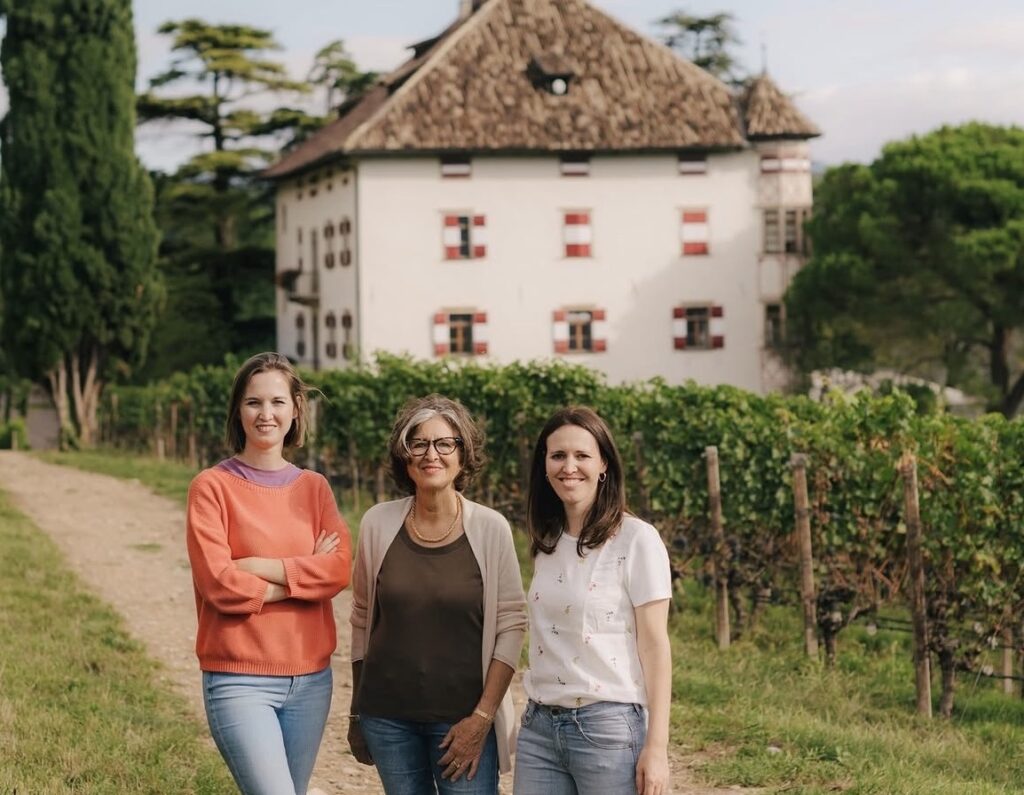
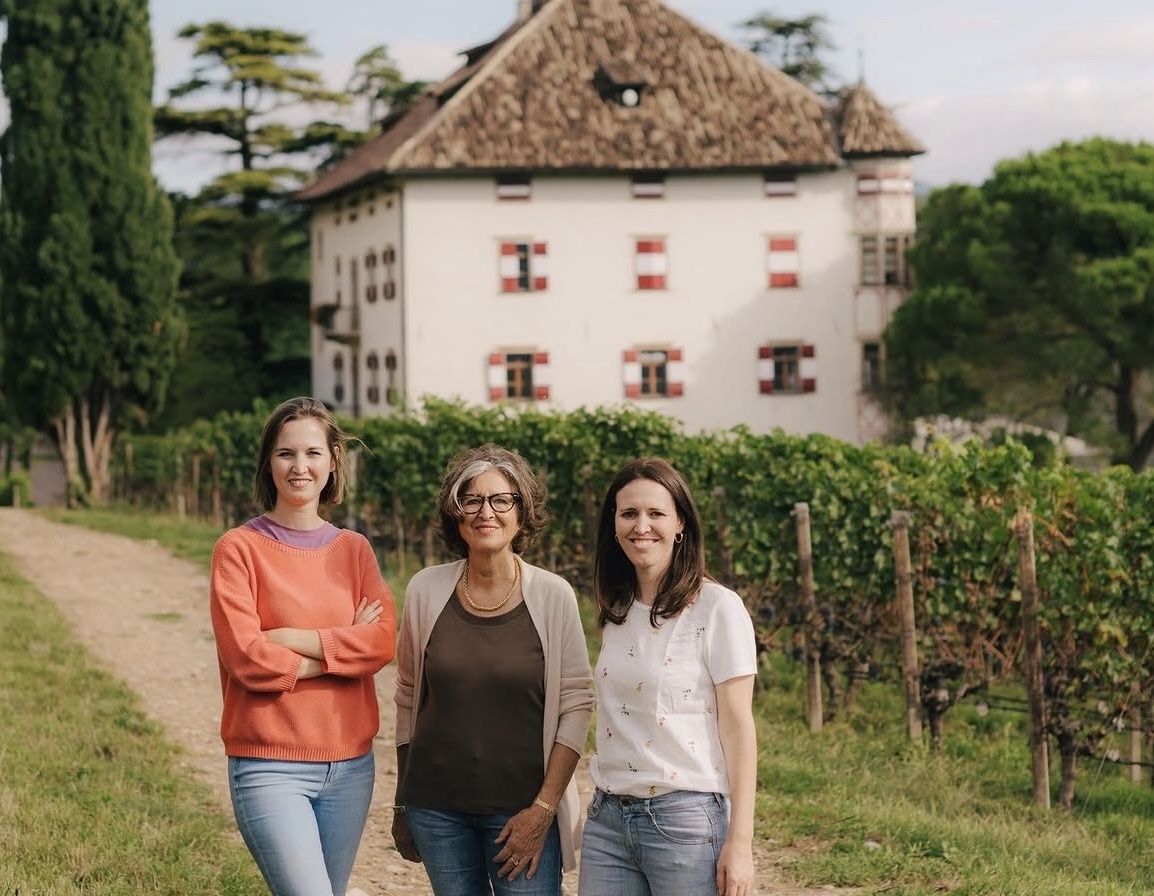
The decline had less to do with quality than with ambition. Schiava was planted everywhere, cropped heavily, and sold cheap. As Karoline Walch (photo: far left next to her mother Elena and sister Julia) of Elena Walch told Grape Collective Senior Editors Dorothy Gaiter and John Brecher: “Mistakes were made in the ’70s. Historically it was produced on a larger scale and probably produced in areas where it shouldn’t be planted.” But producers who got serious about it — choosing the right sites, reducing yields, switching from pergola to Guyot trellising — discovered something worth protecting. “Producers who really believe in Schiava make beautiful wines,” Karoline told them.
In the glass, Schiava is pale ruby, almost translucent. The nose delivers fresh strawberry, cherry and a hint of almonds. On the palate it is light-bodied with soft, silky tannins and lively acidity. Dottie and John described the Elena Walch Schiava as “so light it seemed to float, with nice acidity, soft tannins, and earthy, raspberry notes,” comparing it to “a young, very good Beaujolais, but more weightless, wearing nothing but a smile.” Read their full piece here.
At the table, Schiava is one of the most versatile reds you can open. Karoline told Gaiter and Brecher it works with cured meat, antipasto, white meat, and even seafood, thanks to its fresh acidity and silky tannins. It handles spice well so it works with Asian cuisine. It can be served slightly chilled.
Elena Walch ferments Schiava in stainless steel for seven to ten days, then matures it in enormous hand-carved oak casks that have been in the family for generations — some holding nearly 5,000 gallons. Alois Lageder brings similar seriousness to the variety. Both bottles cost under thirty dollars.
Karoline’s summary to Gaiter and Brecher captures the appeal: “It’s a social wine. It brings people together and you don’t think about it too much.”