BYOB is especially contentious right now.
As wine lovers with our own small collection, we’ve always looked for restaurants that allow us to bring an exceptional bottle and pay a corkage fee. We’ve written about BYOB over the years and we know that some restaurateurs really dislike it. As one told us once: “What’s next? Letting people bring their own steaks?”
But opinions about BYOB are at a high pitch right now. We recently joined Laurie Forster on her podcast, “The Sipping Point.” It was a great deal of fun. We talked about BYOB and corkage for just a few minutes of the conversation, but the feedback hasn’t stopped.
We wondered why this debate has reached such a fever pitch now and we guess the economy has a lot to do with it, though saving money has never been our motivation to bring our own bottles. We’d guess that, on the one hand, some consumers are trying to make the most of every night out and therefore maybe are more likely to take a special bottle of their own and pay corkage. We know that diners, including us, are recoiling at the often outrageous markup on wine at too many restaurants these days.
On the other hand, this is a very stressful time for restaurants. We can understand that a restaurant with a thoughtful list chose those wines for a reason and wants to share them — and be compensated appropriately. We appreciate that their costs include proper storage for their wine, nice glasses and their care, tableside service by knowledgeable servers, and, in fine-dining establishments, a somm or wine director’s salary. BYOB means restaurants are not selling as many of their own wines as they would like, so they can’t as quickly offer new wines. And we know that restaurants have been burned by too many diners who buy a cheapo, pedestrian bottle at the corner shop before they come in just to save money. At a time when too many restaurants are struggling to survive, that’s especially painful.
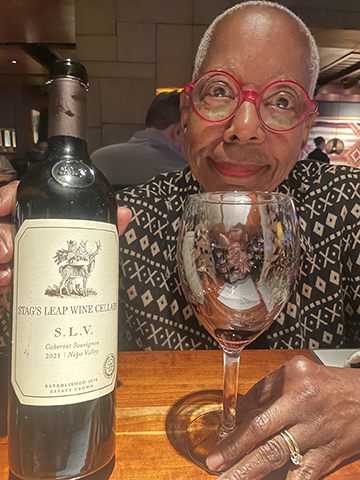
All that said, we believe that BYOB, when handled well by both sides, can be a win for everybody. We seek out restaurants that welcome BYOB, so that traffic is certainly a positive. We happened into a little Indian place in Manhattan recently that had a dreadful little wine and beer list but outstanding food. At the bottom of the menu it said, “Corkage: $15.” We can’t wait to return.
Here are some ideas for both sides of this equation, which might not be perfect, but perhaps are a start. Be aware that there might be laws about BYOB in your locality or state.
1) In our case, we don’t BYOB the first time we go to a restaurant (unless, of course, it doesn’t have a liquor license and invites it). Some restaurants have wine lists filled with such interesting bottles, clearly chosen with passion, that we can’t wait to try their wines; their choices are much of the attraction of the place for us, so we don’t ever want to do BYOB. But when we go to a place we’d like to visit again that seems like a spot where we’d like to bring our own special bottle, we’ll investigate further. Current example: We just had a lovely meal at an informal Italian place in our neighborhood with a good, but not special, list. When we got home and made reservations to go again, we saw that online it says: “Corkage: $35 for Wines & for Champagne/Sparkling, $45 Magnums.” Bingo!
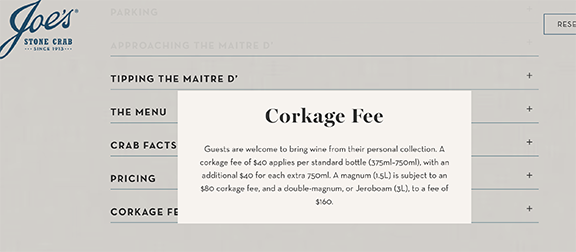
2) Quite a few restaurants will have their policy online and, like Hillstone, on their menus. For example, Joe’s Stone Crab in Miami, which we wrote about recently, says on its menu: “Guests are welcome to bring wine from their personal collection. A corkage fee of $40 applies per standard bottle (375-ml-750 ml), with an additional $40 for each extra 750ml. A double magnum or Jeroboam (3 L) is subject to a fee of $160.” If you go someplace you like, ask about it or call later. You want to be sure that BYOB is OK.
3) Never take a wine that’s on the restaurant’s wine list. That’s just wrong. How do you know? If the wine list is not online, call and ask. In any event, the bottle you take should be special enough that it almost surely would not be on the list, which brings us to….
4) Don’t take your most recent grocery store purchase. We’re sure you may think that wine is delicious and really great at home, but dining out is special and your wine should be, too. That doesn’t mean it has to be a First Growth Bordeaux from your birth year, just something that is appropriately personal to you. In our experience, grocery store shelves are filled with pretty ordinary, mass-produced wines. For our local trattoria, we took a David & Nadia Grenache Noir from South Africa. Why? Because we once met Nadia Sadie in Stellenbosch and wrote a column about the couple for Valentine’s Day. Plus, Zoë, whose birthday we were celebrating, just started a new job and her supervisor’s name is Nadia. So a wine from David & Nadia had a sweet, multi-layered significance for us. We knew the restaurant did not have it because it has an all-Italian list that, helpfully, is online should we want to take an unusual Italian wine in the future.
5) Know the corkage fee before you go. In New York these days, we’d say $35 to $45 is pretty common. That’s a lot of money to pay someone to open a bottle of wine and offer a couple of glasses — and we’ve acknowledged above some of the restaurant’s attendant costs — but we’d rather have a bottle of our own that’s special to us with a good meal than a so-so bottle, and we’re willing to pay for that privilege.
6) Here’s one for the restaurants: Don’t say you welcome BYOB and then act like we’re stealing from you when we bring our own. We’ll never be back, BYOB or not. We have been to more than one restaurant that took away its nice stemware and brought industrial glasses when they saw we brought our own wine or were ordering a wine by the glass. Don’t explain to us why that makes sense — it’s simply rude and unwelcoming.
7) Perhaps also order a glass of wine from the wine list. We understand this isn’t always possible — if you are already splitting your own bottle of wine for two, that would be a lot — but we think it shows respect for the restaurant. It also allows us to slow things down to our pace.
8) Give your server a word or two about why you brought that wine and offer a taste. This is not only polite, but makes wine the communal beverage it should be. In the case of David & Nadia, for instance, we said, “This is a wine from a South African couple we met on our first trip to South Africa. Please, pour yourself a taste.” Servers generally decline, but we remember once when our server loved the wine so much that he shared the glass with several other servers and cooks. Another time, the server didn’t drink so he shared the glass with the wine director. One told us he’d never had such an old wine. It can be a learning experience for the server and their colleagues.
9) Tipping — oh, my. We know that tipping on a bottle of wine is itself a matter of great debate. When we order a bottle of wine, we generally tip about 20% on the entire check. We have heard from other people who say they tip per bottle — say, $10 — on the theory that it takes the server the same amount of time to open a $30 bottle as a $100 bottle. We disagree, but that’s a whole ’nother column. In any event, BYOB is a bit more complex. Yes, we are already paying corkage, but it doesn’t seem fair for the server to take a hit because we’re not paying for the restaurant’s wine. So we make it a point to tip generously when we BYOB. To us, it’s all about trying to be respectful.
10) Whether or not you’re doing BYOB, when you enter a place whose sole purpose is to provide you with sustenance, be it a humble, hole-in-a-wall joint or an extravagant splurge, you and it are engaging in a mutual act of hospitality, civility and appreciation. With that in mind, everything will be great.
Dorothy J. Gaiter and John Brecher conceived and wrote The Wall Street Journal’s wine column, “Tastings,” from 1998 to 2010. Dorothy and John have been tasting and studying wine since 1973. In 2020, the University of California at Davis added their papers to the Warren Winiarski Wine Writers Collection in its library, which also includes the work of Hugh Johnson and Jancis Robinson. Dottie has had a distinguished career in journalism as a reporter, editor, columnist and editorial writer at The Miami Herald, The New York Times, and at The Journal. John was Page One Editor of The Journal, City Editor of The Miami Herald and a senior editor at Bloomberg News. They are well-known from their books and many television appearances, especially on Martha Stewart’s show, and as the creators of the annual, international “Open That Bottle Night” celebration of wine and friendship. The first bottle they shared was André Cold Duck. They have two daughters.