Bottom line: Winemakers around the world are discovering that the ocean’s depths provide a unique aging environment that can transform wine in remarkable ways – though the practice comes with both scientific intrigue and regulatory hurdles.
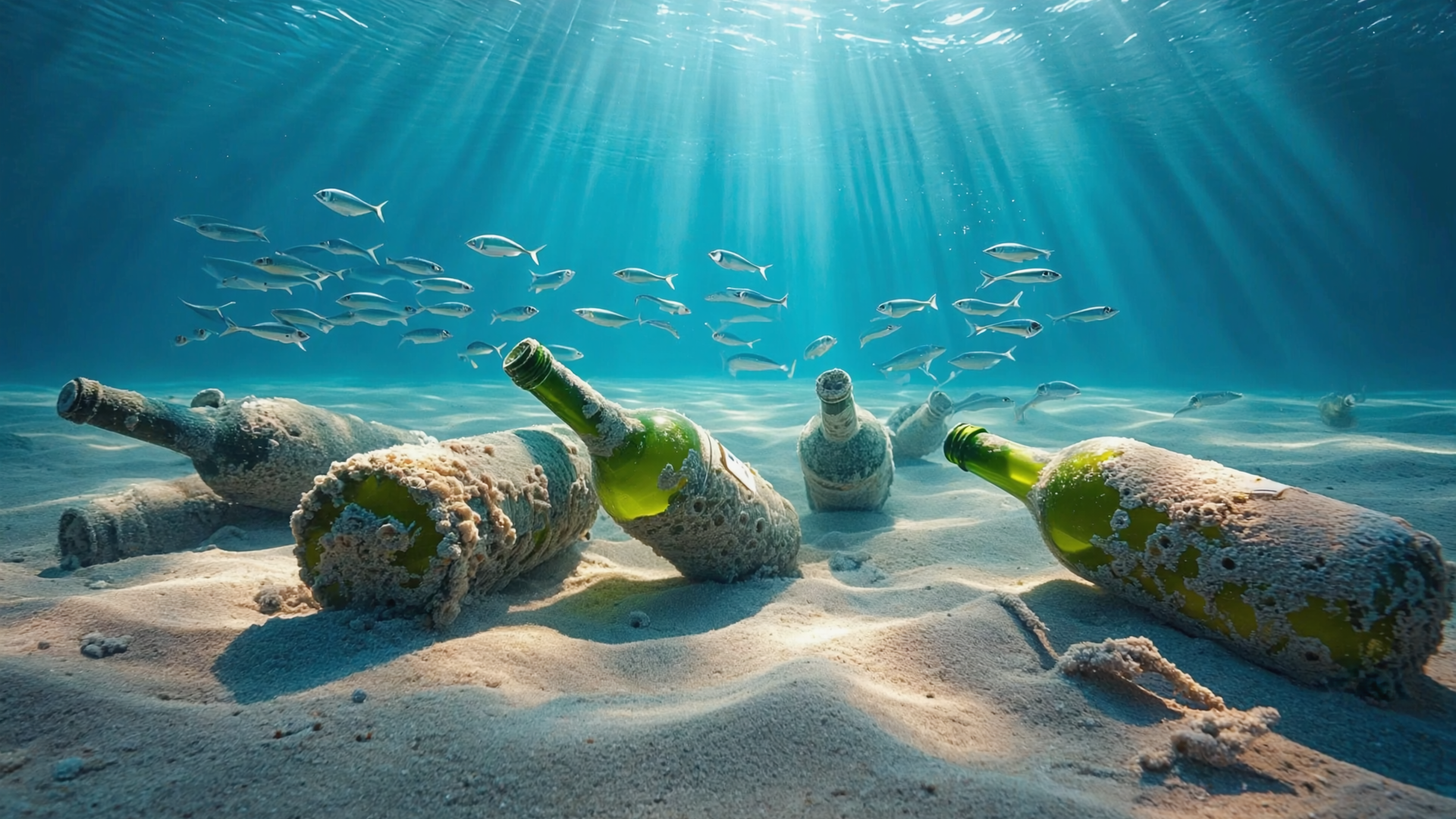
Forget dusty cellars and temperature-controlled caves. The wine world’s newest frontier lies beneath the waves, where bottles rest in the ocean’s embrace, accumulating barnacles and developing flavors that would be impossible to achieve on land. What started as inspiration from centuries-old shipwreck discoveries has evolved into a legitimate winemaking technique that’s captivating producers from Champagne to California, Spain to Santorini.
The Unexpected Origins of an Ocean Cellar
The modern underwater wine aging movement traces its roots to a remarkable discovery in 2010. When divers exploring an 1840s shipwreck off the coast of the Finnish Åland Islands in the Baltic Sea discovered 168 bottles of Champagne, which were subsequently extracted by the Åland regional government, something extraordinary was revealed. Some of the bottles of that Veuve Clicquot Champagne, brought up in 2010 from the Baltic Sea, later sold for as much as $30,000 apiece. But it wasn’t just their rarity that commanded such prices – the wines had maintained their sparkle and developed remarkable complexity after more than a century underwater.
This discovery didn’t just create headlines; it launched a thousand underwater experiments. Winemakers began to wonder: if the ocean could preserve and potentially enhance wine for over 160 years, what could a controlled underwater aging process achieve?
The Science of Submarine Cellaring
The ocean creates an almost perfect aging environment through a combination of physical conditions that would be impossible to replicate in traditional cellars. The ocean floor’s consistent, cool environment makes Poseidon’s pantry an ideal cellar. Wine Spectator explains why temperature matters in wine storage. Plus, the increased pressure, nearly four times that on land, speeds up the chemical reactions that mature the wine, resulting in a faster, yet balanced aging process.
The key factors that make underwater aging so compelling include:
Constant Temperature: Median temperatures at the bottom of the ocean in these regions maintain 50-55° F, providing the steady conditions wine needs for optimal aging without the fluctuations that can damage wine in traditional storage.
Pressure Dynamics: Pressure plays the critical role in underwater ageing, with around 1 bar per 10m of depth. Therefore, at between 50 and 60m, the pressure outside a bottle of submerged Champagne broadly equals that within. This pressure equilibrium creates unique conditions for sparkling wines, where “Under pressure, the slow work of autolysis becomes more focused, and accordingly, the wine has more definition and character”.
Complete Darkness: Just as our skin ages faster under the sun, so does wine. UV light excites the molecules in wine, causing unwanted reactions that can ruin its flavor. Thankfully, the ocean keeps our precious bottles safe in its dark, serene depths, far from harmful rays.
Natural Movement: The ocean’s currents provide a gentle, constant motion that some winemakers liken to the riddling process used in Champagne production. The movement of the sea itself – which produces a ‘continual vibrating effect’ on the wines, potentially accelerating the integration of flavors and aromas.
Pioneers of the Deep
The underwater wine movement has attracted innovators across the globe, each bringing their own approach to oceanic aging.
Spain’s Crusoe Treasure operates what they call “the world’s first” underwater wine cellar, houses thousands of bottles, each aging gracefully in the deep in the Bay of Plentzia. Their 12 years of research has shown how underwater wines can develop different characteristics, according to Antonio Palacios, the group’s oenology director and also a specialist in chemical analysis who created the Excell Iberica lab in 2008.
Croatia’s Edivo Vina has taken the concept even further, encasing their bottles in amphorae, replicating the traditional Roman way of wine storage. The result? A unique, sea-salt-tinged wine that offers an immersive taste of history, aptly named ‘Navis Mysterium.’
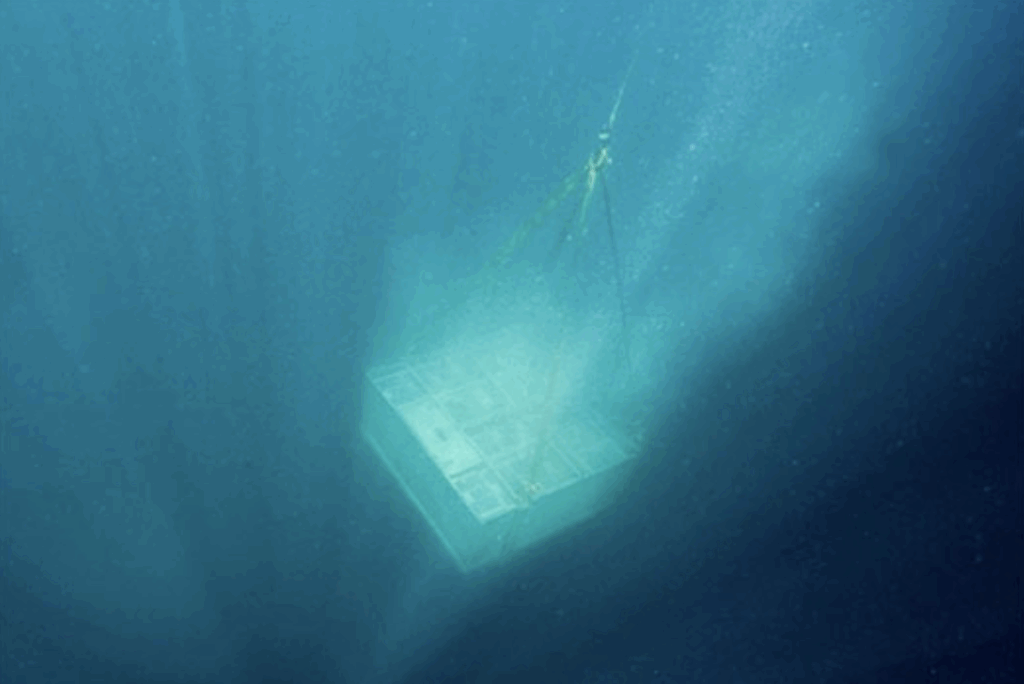
Champagne Houses have been particularly drawn to underwater aging. Champagne Drappier also chose the Atlantic to create Immersion. ‘Ageing wine under the sea allows for a constant temperature and ideal obscurity, with the motion of the waves assisting the process,’ says Michel Drappier. Meanwhile, biodynamic producer Leclerc Briant has created a special underwater cuvée named ‘Abyss’. Now in the fourth year of the project, 4,000 bottles of the 2016 vintage are currently 60 metres below the water line in the sea off France. Herve Jestin, winemaker at Leclerc Briant commented to Grape Collective: “We left some bottles aging under the sea at 60 meters deep just close to the bottom and we let the barrel aging around 15 months at 60 meters deep without any oxygen, with the same pressure inside. The interesting thing is the energy in this place because you have a permanent water dynamization which means that the energy in the bottle is 30% more than the same bottle aging in our cellar.”
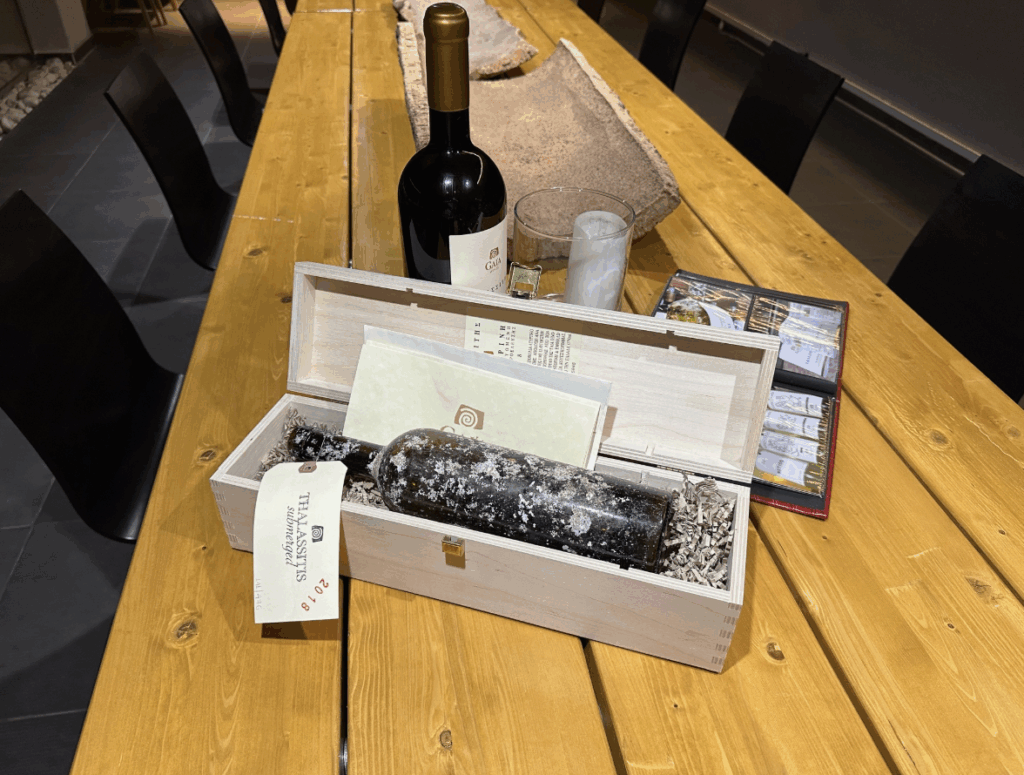
Greek Innovation: On the volcanic island of Santorini, Gaia Winery has been experimenting with submerging their Assyrtiko under the Aegean Sea since 2009. Despite early setbacks including storms and cork failures, its most recent vintage (2018) is both breathtaking and baffling in equal measure, combining freshness with the satisfying complexity usually associated with oxidative ageing. Leon Karatsalos, co-founder of Gaia Winery spoke to Grape Collective: “Our water-aged wine, we do that with Thalassitis, which is the first product we produced from Santorini. There has become a craziness with this wine. I think that it has supported a lot Thalassitis and the brand. People want to see how the wine evolves and ages under the sea.”
Tasting the Difference
But does underwater aging actually change how wine tastes? The evidence suggests it does, though the changes are often subtle and require careful comparison.
Comparative tastings reveal fascinating differences. While the nose of both the immersed and conventional bottle were very similar, the immersed version showed much more tension and energy on the palate compared with the normal bottling, which appeared to have a creamier and smoother texture.
Attributes of the underwater wines include ‘greater intensity of colour’ and a slower evolution of the wine’s hue over time, Palacios told Decanter via email. When it comes to smell, the wines have ‘greater intensity’ and tend to show fewer herbaceous and vegetable aromas, with accentuated primary fruit and floral notes, he said. On the palate, he described the wines as having a ‘silkiness’ with a greater sense of freshness.
Some producers report even more dramatic changes. Argentinian winemaker Patricia Ortiz recently reported ‘stunning’ differences between Malbec blends aged in crates beneath the Atlantic Ocean and those on land, after a trial at her Wapisa winery in Patagonia. ‘We tasted the underwater-aged wine and the cellar-aged counterparts blind, the difference was stunning: the former was rounder, more elegant and with fresher fruit.’
Navigating Troubled Waters
Despite the excitement surrounding underwater aging, the practice faces significant challenges. The most notable obstacle comes from U.S. regulators, who declared that underwater aging was a contravention of the Federal Food, Drug and Cosmetic Act in 2015. The Alcohol and Tobacco Tax and Trade Bureau (TTB) issued an advisory “in response to recent interest in the aging of wine under ocean waters”, effectively banning the practice for wines sold in the United States.
The regulatory concerns center on potential contamination risks. Changes to pressure under the water line could in theory allow contaminants from gasoline to ‘various types of filth’ to get inside the bottle, said an advisory note from the TTB published in March 2015. However, the FDA issued a letter of no objection to a wine importer in Wisconsin, permitting the business to import wine bottles aged in the Adriatic Sea by a specific winery that had submitted a significant amount of evidence on product safety, suggesting that case-by-case approvals may be possible.
The enforcement of these regulations has real consequences. The Santa Barbara County District Attorney’s Office announced that, with the assistance of the City of Santa Barbara, California, and the California Bureau of Alcoholic Beverages Control, it had “disposed of approximately 2,000 bottles of wine and other alcohol . . . in connection with an illegal underwater wine aging and sales operation” in 2023.
The Future Beneath the Waves
Despite regulatory hurdles and practical challenges, underwater wine aging appears to be more than just a passing fad. Recent scientific research supports what winemakers have been observing through taste. This study has investigated the aging of Merlot and Sangiovese wines under traditional cellar conditions and underwater, exploring the influence of storage parameters on their chemical evolution. Analyzing parameters such as temperature, pressure, and chemical composition, the research revealed subtle but significant changes in the wines over time.
The appeal extends beyond just the wine itself. ‘It has a great marketing potential as you can talk about many more new things other than vineyards and terroir,’ said Juan Park, director for Spain and South America at consumer research group Wine Intelligence. The visual drama of barnacle-encrusted bottles and the romance of oceanic aging creates a compelling narrative that resonates with consumers seeking unique experiences.
There is no shortage of space for it (though the seabed must be leased and off limits for fishing trawlers), and the process of temperature control is natural, after all. The thirst from curious collectors currently appears unquenchable.
As climate change challenges traditional wine regions and storage methods, the ocean’s consistent conditions may become increasingly attractive to winemakers. Whether underwater aging proves to be a lasting innovation or an intriguing experiment, it represents the wine industry’s endless quest to push boundaries and discover new expressions of terroir – even if that terroir happens to be at the bottom of the sea.
The early pioneers are already proving that when it comes to wine aging, sometimes the most revolutionary approach is to dive deeper rather than dig down.