Right about now, every wine writer will recommend the perfect bubbly for entertaining or gifting this season. But there’s a big world of wine stores, and it’s impossible to know if any specific sparkler will actually be available where you shop. We’d guess that’s why many people take a quick look around and say, fine, I’ll stick with Veuve Clicquot, since VC is widely available, reliable and can be identified by initials.
But wouldn’t it be nice to try something different, something that stretches the bounds of bubbledom just a bit and shows your friends and family that you put extra thought into this? Over the past four months, we have been tasting dozens of bubblies from all of the world, mostly sent by winery representatives. We have not just looked for good wines, but for sparklers that say something about a larger, more widely available group of wines. The idea is that while most wines aren’t available everywhere, this will give you some tips to find interesting wines wherever you are. The important thing here is not so much the names of the wines, but what they represent.
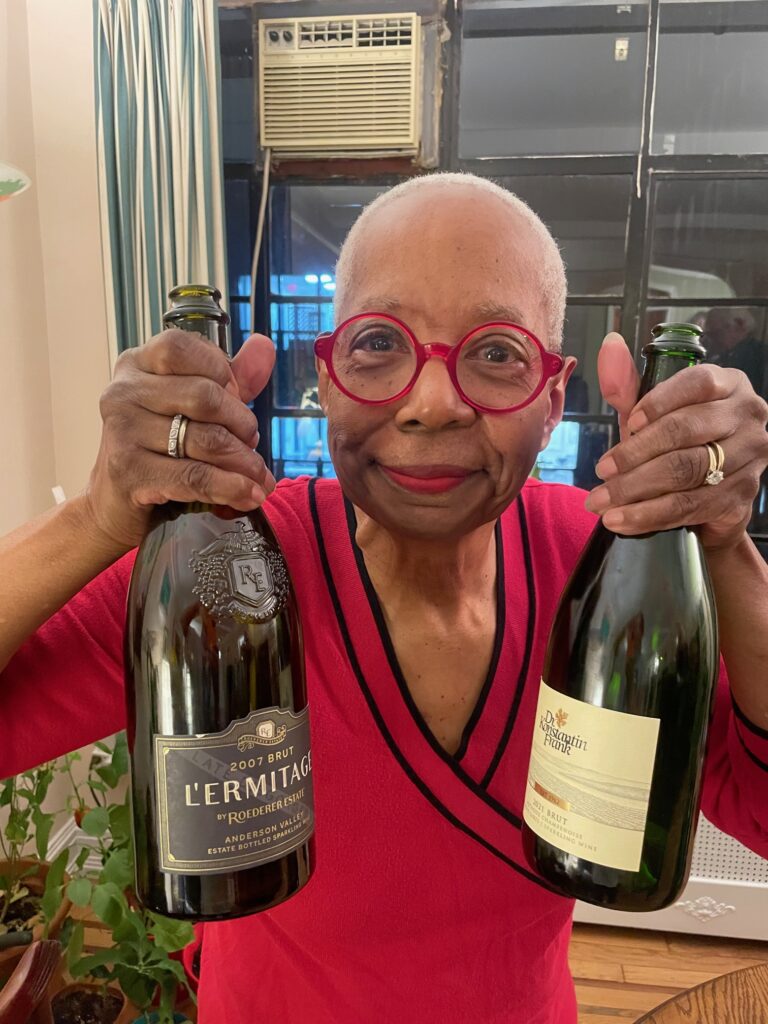
Dr. Konstantin Frank 2021 Brut, Finger Lakes, N.Y. ($35). Konstantin Frank was a pioneer of New York winemaking, introducing vinifera grapes to the Eastern U.S. in 1957 and founding his winery in 1962. Four generations in, the winery still does a great job. This, made the way Champagne is crafted, is quite focused and crisp, with plenty of fruit held tightly in check and elegant bubbles that are integral to the taste. We had planned to have it before brisket, but it was so good that the acidity and fruit turned out to be just right with the sweet, meaty dish. The finish is very clean and it has a nice touch of minerals. It’s elegant, light on its feet and a real bargain, made from 55% Chardonnay, 40% Pinot Noir, and 5% Pinot Meunier.
This can be hard to find even in New York, but it points to something important: There are wineries in all 50 states and many of them make sparkling wine. One winery might be close enough to you that you can make a day trip or have wine shipped to you. Think about how much it would mean to your friends and family to say “I picked this up at [or ordered this from] a winery that’s not too far from here.”
Scharffenberger 2019 Blanc de Noirs, Mendocino County ($40). This is lemony and fine, with lovely bubbles. It’s quite crisp and elegant, with a beautiful finish. We were surprised that it is $40 because we would have guessed it cost more. Made Champagne-style from Pinot Noir, Pinot Meunier and Pinot Gris, it’s that classy.
We have been fans of Scharffenberger, founded in 1981, for a very long time. It was our best of tasting in a column for The Wall Street Journal in 1998, the inaugural year of our column. Since 2004, the winery has been owned by Louis Roederer, among the growing force of French companies planting flags in the U.S. wine industry. The larger point here is that there are bubbly houses in the U.S. that have been setting the standard for a long time, including Domaine Carneros and pioneering Schramsberg. If you want to stick with a home-grown sparkler with an excellent track record, you have choices.
M. Chapoutier 2022 La Combe Pilate Esteban Brut Nature Vin de France ($40) and Adami Col Fondo Valdobbiadene DOCG Prosecco Superiore Brut Nature ($24). These two would appear to have nothing in common, beyond both being made by the traditional Champagne method. The first is from the Rhône Valley and is made from 100% Viognier, which is a surprise. It has a lot of green apple that Dottie liked more than John did, but we both enjoyed the dry “have another sip” finish. The second is a Prosecco from Italy from 100% Glera grapes that clocks in at a welcoming 11% alcohol. It’s extremely crisp and focused, with a purity that really packs a punch. Bearing the prestigious DOCG designation, it’s a great deal.
Look closely and you’ll see what they share: “Brut Nature.” When we were growing up in wine, we knew that Brut meant that a Champagne was very dry, though it still had a bit of dosage — sweet stuff — to cut through the abundant acidity. We didn’t even know there was a higher order of dryness until we visited Champagne in 1984 and the first wine we had was Taittinger “Brut Absolut,” made with no dosage. The utter dryness was a revelation — we felt we could taste the winemaker and the chalky soil. Since then, we look for bubblies that indicate that they are super dry. It can be Brut Nature or Extra Brut (but not Extra Dry, which means it’s actually less dry than Brut — go figure). This would be something different to share. As always, this doesn’t mean you have to geek out about it, but one sentence — “I read that ‘Extra Brut’ means it’s super dry and I thought we’d enjoy that” — would be nice.
L’Ermitage by Roederer Estate 2007 Brut Late Disgorged, Anderson Valley ($120). Be prepared: This is not an exuberant bubbly to be opened at midnight. It’s profound and deep and tastes like age. It has a touch of acacia honey, tangerine and some toast — a tightrope walk — all balanced, flowing into a mouth-filling whole. This isn’t for everybody, but people who like wine — and probably many in-laws — would likely love this. Sparklers like this always take us back to the very first Bollinger R.D. (recently disgorged) we ever had, which made us realize we’d been missing something.
What’s important here is two-fold: One is that sometimes a wine is expensive for a reason, not just because of a posh label. Wines like this are held in the winery for an extended time before they are disgorged — when the lees and other stuff are popped out — and released. In this case, it says on the back label that it was disgorged in November 2024, which means it was in the winery for 17 years, an expensive proposition.
Second, late-disgorged bubblies are special. They might require an extra search, and probably some real money, but they add a dimension to bubbly enjoyment. (In general, whether late disgorged or not, we like bubblies with some age, which we think adds complexity, depth and texture. The 1976 Bollinger jeroboam that we opened for the Millennium –the equivalent of four bottles–was one of the all-time greats. But you need to be sure that an older bubbly has been stored properly.)
Enrico Serafino 2020 Oudeis Brut Rosé de Saignée Alta Langa ($38). We have recommended this wine before because it’s so very elegant and romantic. And here’s the point: It’s from someplace you might not expect, the Piedmont region of Italy, famous for Barolo and Barbaresco. As its name indicates, it’s from juice bled off a red grape, in this case Pinot Noir, and made like Champagne, with the second fermentation, which produces the bubbles, occurring in the bottle. Keep your mind open when it comes to fine bubbly because there are very thoughtful wines out there that you might not often see, like Trentodoc, which comes from the Trentino region of Italy and made by the classic method of Champagne (the one you are most likely to see is Ferrari, which is excellent).

Bon Vivant Brut and Bon Vivant Rosé, California ($20 each). These were simply from “California,” with little other information, which worried us because that can be a sign of a generic wine without much thought or interest. They are a lower-end label of Scharffenberger, both made from 60% Chardonnay and 40% Pinot Noir in the traditional Champagne method. Their 11 grams of sugar would indicate that they are off-dry. We opened the white first and were very surprised: “Grapefruit like acidity. Very drinkable and easy, with no fuss,” we wrote. “This could definitely be a house bubbly, and we’d also greet visiting friends with it. It’s not a wine to talk about, just to enjoy.” Because of good acidity, it did not come off as sweet.
Then we had the rosé: “At first, we thought this was just slightly not as good as the white–just a slight bit sweeter. But in a short time, it became just as pleasant, and not too sweet. Dottie talked about its ‘juicy charm.’ She had made mac ‘n cheese and we had planned to open a red, but this was so good with the creamy dish — nice acidity, vibrant fruit — that we just kept drinking it. It’s quite a bang for the buck. We’d serve this at a garden wedding.”
Our point here is that inexpensive doesn’t have to mean cheap. There are so very many inexpensive bubblies on shelves these days that would be just fine as an ingredient of a mimosa or a Bellini. But you don’t have to settle for OK, especially when you plan to share a bottle, or give a bottle, to friends or family. If you are getting an inexpensive untried bottle to be shared, we’d urge you to buy a bottle now and taste it. Yes, that’s right — force yourself to drink a bottle of bubbly for no reason at all. If it’s not good enough to share, darn it, you might be forced to go try a different one. The holidays are a good time to share, but also a great time for personal exploration.
Dorothy J. Gaiter and John Brecher conceived and wrote The Wall Street Journal’s wine column, “Tastings,” from 1998 to 2010. Dorothy and John have been tasting and studying wine since 1973. In 2020, the University of California at Davis added their papers to the Warren Winiarski Wine Writers Collection in its library, which also includes the work of Hugh Johnson and Jancis Robinson. Dottie has had a distinguished career in journalism as a reporter, editor, columnist and editorial writer at The Miami Herald, The New York Times, and at The Journal. John was Page One Editor of The Journal, City Editor of The Miami Herald and a senior editor at Bloomberg News. They are well-known from their books and many television appearances, especially on Martha Stewart’s show, and as the creators of the annual, international “Open That Bottle Night” celebration of wine and friendship. The first bottle they shared was André Cold Duck. They have two daughters.