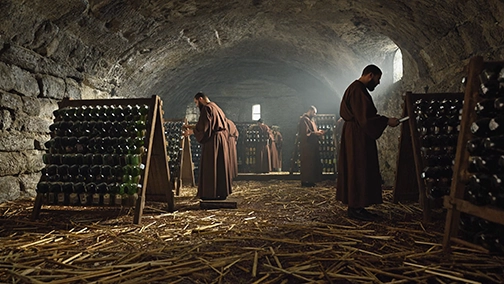
When you pop open a bottle of Champagne, you’re not just celebrating—you’re participating in a tradition steeped in bloodshed, political intrigue, and centuries of manipulation. The sparkling wine we associate with luxury and celebration has a dark and fascinating history that textbooks conveniently omit. From wartime destruction to economic warfare, from religious persecution to international espionage, Champagne’s story reveals the brutal realities behind one of the world’s most coveted beverages.
The Monk Who Didn’t Invent Champagne
The most persistent myth about Champagne involves Dom Pierre Pérignon, the Benedictine monk supposedly responsible for “inventing” the sparkling wine in the late 17th century. This romantic tale of a holy man discovering bubbles in his cellar makes for excellent marketing, but it’s largely fabricated. The reality is far more complex and considerably less spiritual.
Sparkling wine existed in the Champagne region decades before Pérignon arrived at the Abbey of Hautvillers in 1668. English scientists and winemakers were already producing intentionally sparkling wines using a method called “méthode ancestrale” by the 1660s. The English even had stronger glass bottles capable of withstanding the pressure—a crucial technological advancement that French glassmakers hadn’t yet mastered.
What Dom Pérignon actually contributed was marketing genius and quality control. He understood that controlling the narrative around Champagne would be just as important as perfecting the product. The Abbey of Hautvillers became a powerful brand, and the monk’s supposed “discovery” provided the perfect origin story for what would become France’s most valuable wine export.

The Religious Wars That Shaped Champagne
The Champagne region’s development was profoundly influenced by centuries of religious conflict that most wine histories gloss over. During the French Wars of Religion in the 16th century, the region became a battleground between Catholics and Huguenots (French Protestants). Vineyards were systematically destroyed, monasteries burned, and entire wine-making communities massacred.
The revocation of the Edict of Nantes in 1685 by Louis XIV forced hundreds of thousands of Huguenots to flee France, taking their wine-making expertise with them. Many settled in England, where they shared their knowledge of sparkling wine production with English vintners. This exodus inadvertently gave England a significant head start in sparkling wine technology, creating competition that French producers would spend centuries trying to overcome.
The religious persecution also consolidated power among Catholic monasteries and wealthy noble families who remained loyal to the crown. This concentration of ownership would later enable the systematic control of Champagne production that persists today. The great Champagne houses—Moët, Veuve Clicquot, Krug—were all founded by families who either survived the religious purges or benefited from the property confiscations that followed.
The Napoleonic Wars and Champagne’s Blood Money
Napoleon’s relationship with Champagne reveals the wine’s deep entanglement with military conquest and political power. The Emperor wasn’t just a consumer of Champagne—he weaponized it as a tool of diplomacy and psychological warfare. Before major battles, Napoleon would ensure his officers received Champagne rations, not for morale but to demonstrate French superiority to enemy forces who might capture the supplies.
The Napoleonic Wars devastated the Champagne region multiple times. The 1814 invasion by Russian, Prussian, and Austrian forces resulted in the systematic looting of Champagne cellars. However, this apparent disaster became a marketing triumph. Champagne producers discovered that occupying armies made excellent customers and even better advertisements. Russian officers developed such a taste for Champagne that they continued importing it long after the wars ended, creating a luxury market that subsidized French military ambitions for decades.
The most shocking aspect of this period was how Champagne producers actively collaborated with occupying forces while maintaining their French patriotic image. Companies like Moët & Chandon sold Champagne to Napoleon’s enemies while simultaneously supplying the French army. This calculated opportunism established a pattern of political flexibility that would serve Champagne producers well during future conflicts.
The Phylloxera Conspiracy
The phylloxera epidemic of the 1860s through 1890s is typically presented as a natural disaster that randomly devastated European vineyards. The reality involves industrial espionage, international sabotage, and calculated economic warfare that fundamentally reshaped the global wine industry.
American vine specimens carrying the phylloxera aphid didn’t accidentally make their way to Europe. They were part of deliberate efforts by American botanical collectors and wine industry representatives to study European wine-making techniques. Some evidence suggests that certain American interests hoped to cripple European wine production to create market opportunities for New World wines.
The Champagne region’s response to phylloxera reveals the ruthless business practices that built the modern industry. While small producers went bankrupt by the thousands, large Champagne houses used the crisis to consolidate their holdings at depression prices. They also began the systematic adulteration of Champagne with cheaper wines from other regions—a practice that continued for decades and was only gradually regulated.
The phylloxera crisis also accelerated the development of Champagne’s appellations system, but not for the noble reasons usually cited. The regulations were designed to exclude smaller producers and maintain the dominance of established houses. Many traditional Champagne villages were deliberately left out of the protected designation, forcing their producers out of business and allowing large companies to acquire their vineyards cheaply.
World War I: The Trenches Run Through Champagne
World War I transformed the Champagne region into a literal battlefield, with trenches cutting directly through some of the world’s most valuable vineyards. The Western Front’s Champagne sector saw some of the war’s bloodiest battles, with over 400,000 casualties in the Champagne offensives of 1915 alone.
What textbooks don’t mention is how Champagne producers turned the war into a marketing opportunity. Companies like Pol Roger and Krug actively promoted their wines to British and American officers, positioning Champagne consumption as a patriotic duty. They marketed the idea that drinking Champagne supported French resistance against German aggression, even though much of their production was actually moved to safer regions during the conflict.
The underground chalk caves that stored Champagne also served as bomb shelters and military command centers. Some producers charged rent to military units for using their cellars, profiting from the war while their neighbors’ homes were destroyed. After the war, these same companies claimed their cellars had been “heroically preserved for France,” conveniently omitting their wartime profit-taking.
The post-war reconstruction of Champagne vineyards was subsidized by German reparations payments, meaning Germany literally paid to rebuild the industry that would later celebrate Allied victory. This irony was carefully hidden from marketing materials that emphasized Champagne’s role in French resistance.
The Nazi Occupation and Collaboration
World War II revealed the Champagne industry’s capacity for moral compromise in stark detail. When German forces occupied the region in 1940, most major Champagne houses quickly reached accommodation with Nazi authorities. The collaboration went far beyond simply continuing production under occupation—it involved active participation in Nazi economic policies.
Otto Klaebisch, the German “Weinführer” appointed to oversee Champagne production, worked closely with French producers to maximize output for German consumption. Companies like Moët & Chandon, Mumm, and Piper-Heidsieck produced millions of bottles specifically for Nazi officials and German military units. The irony that Hermann Göring’s wedding featured French Champagne while the Luftwaffe bombed London was lost on few observers.
Some Champagne producers went even further, using forced labor from concentration camps and prisoner-of-war camps to maintain production. Documents discovered after the war revealed that several major houses had requested additional forced laborers and had paid fees to Nazi authorities for their use.
The post-war whitewashing of this collaboration was remarkably thorough. Companies that had enthusiastically served Nazi customers quickly repositioned themselves as resistance heroes. The few producers who had actually resisted occupation—like the Bollinger family—found their wartime heroism used to rehabilitate the entire industry’s reputation.

The Champagne Riots and Class Warfare
The Champagne Riots of 1911 represent one of history’s most violent wine-related uprisings, yet they’re rarely mentioned in wine education. The riots began when vineyard workers and small producers discovered that major Champagne houses were systematically importing cheaper grapes from outside the region while maintaining premium prices.
The uprising quickly escalated beyond wine fraud to encompass broader class resentments. Angry mobs attacked the mansions of wealthy Champagne producers, destroying equipment and burning records. The government deployed 40,000 troops to restore order—a massive military response that revealed how seriously authorities took threats to Champagne production.
The riots were ultimately suppressed through a combination of military force and economic concessions, but they established a pattern of labor unrest that would plague the industry for decades. The appellation system created in response to the riots was designed not just to protect quality but to prevent future uprisings by formalizing the exclusion of certain producers and regions.
The Modern Champagne Cartel
Today’s Champagne industry operates as a sophisticated cartel that would make medieval guilds envious. The Comité Interprofessionnel du Vin de Champagne (CIVC) controls every aspect of production, from grape pricing to marketing messages. This isn’t regulation—it’s market manipulation on a massive scale.
The CIVC sets production quotas that artificially limit supply, maintains price floors that prevent competition, and coordinates marketing campaigns that present cartel members as individual competitors. The organization also operates an extensive intelligence network that monitors unauthorized Champagne production worldwide and funds legal challenges to protect the Champagne trademark.
Perhaps most shocking is how the Champagne cartel has captured regulatory agencies in multiple countries. Trade negotiators routinely prioritize Champagne trademark protection over broader economic interests, and wine regulations often explicitly favor Champagne production methods over alternatives.
The Truth Behind the Bubbles
The real history of Champagne reveals an industry built on religious persecution, wartime profiteering, collaboration with occupying forces, and systematic market manipulation. The sparkling wine we associate with celebration and luxury has consistently served the interests of power rather than principles.
This doesn’t diminish Champagne’s technical achievements or cultural significance, but it does provide important context for understanding how luxury goods markets actually operate. The next time you raise a glass of Champagne, remember that you’re not just celebrating—you’re participating in a tradition that has survived centuries of moral compromise through careful image management and ruthless business practices.
The shocking history of Champagne they don’t teach you in school reveals that behind every luxury product lies a complex web of political calculations, economic manipulation, and convenient historical amnesia. Understanding this history doesn’t ruin the enjoyment of Champagne—it makes it more interesting and considerably more honest.