The hottest trend in wine might be the quietest: tasting groups designed for connection more than connoisseurship.
To be sure, tasting groups are likely as old as wine. And the number of study groups has exploded along with the rise of formal educational studies, from the Wine & Spirit Education Trust to the Court of Master Sommeliers to the Masters of Wine. Our little tasting group in Miami in the ’70s and ’80s was critical to our own journey. We’d have a theme — say, Chardonnay under $20 — and eight or 10 of us would each bring a bottle in a paper bag. It’s great fun looking back at those notes. In 1987, we had a tasting of American Cabernet Sauvignon with some age. The most popular: Sterling 1976 in magnum. The runner-up was a winery then called Durney.
But, as with so many things, it seemed to us that those small, let’s-have-some-wine-together groups suffered during the pandemic. Several people we met during the recent Wine Writers Symposium at Meadowood Napa Valley wondered if the rise of remote work — from “telecommuting” in the ’70s to standard practice during and after the pandemic — has put a dent in wine, especially among younger people. The theory is that, before the pandemic, people left the office and maybe went out for a glass of wine, but now they stay home and don’t fully experience the social aspects of wine.
We don’t know how prevalent that shift is, but we have sensed a rise of tasting groups among people who connect with us or follow us. We first wrote about wine tasting groups in our Tastings column for The Wall Street Journal, where one was thriving in a senior citizen community. In our book “Wine for Every Day and Every Occasion: Red, White, and Bubbly to Celebrate the Joy of Living,” we wrote a chapter titled “Wine Tasting Groups: Your Neighbors are Doing It.” We led with Jon Sherman, an executive producer on the hit TV show Frasier, who co-wrote its classic, pretentious “Whine Club” episode. He told us, “While wine snobbery is plenty good for jokes on TV, it’s terrible for you, your wine, and your tastings. Wine clubs should bring people together, not set them apart.” That getting-together impetus was especially notable for this year’s Open That Bottle Night celebrations.
One of the more striking OTBN events we heard about was a tasting of Zinfandels with many of our old winery favorites, from Turley to Storybook. Looking into it later led us to a tasting group called The Winer Things and its organizer, Marjorie Wang, 30, a wealth manager in Bloomfield, N.J. “In my opinion, friendship and connection is still the most important thing. Coming out of Covid, I was missing a lot of that,” she told us.
“My husband and I became interested in wine after a trip to Napa about three years ago — prior to that, I honestly thought wine tasted terrible. The switch flipped at the first winery, Twomey, where we actually could taste a difference between two Cabernets.
“When we got home, wanting to continue our wine journey but not really knowing where to start, we were regulars at our local Total Wine’s $5 tastings. At one of these tastings, I heard a voice behind me say ‘we should put together a group to taste more wines and higher-end wines.’ And I immediately whipped my head around and asked for her cell number. She was May Terry, a founding member of our group.”
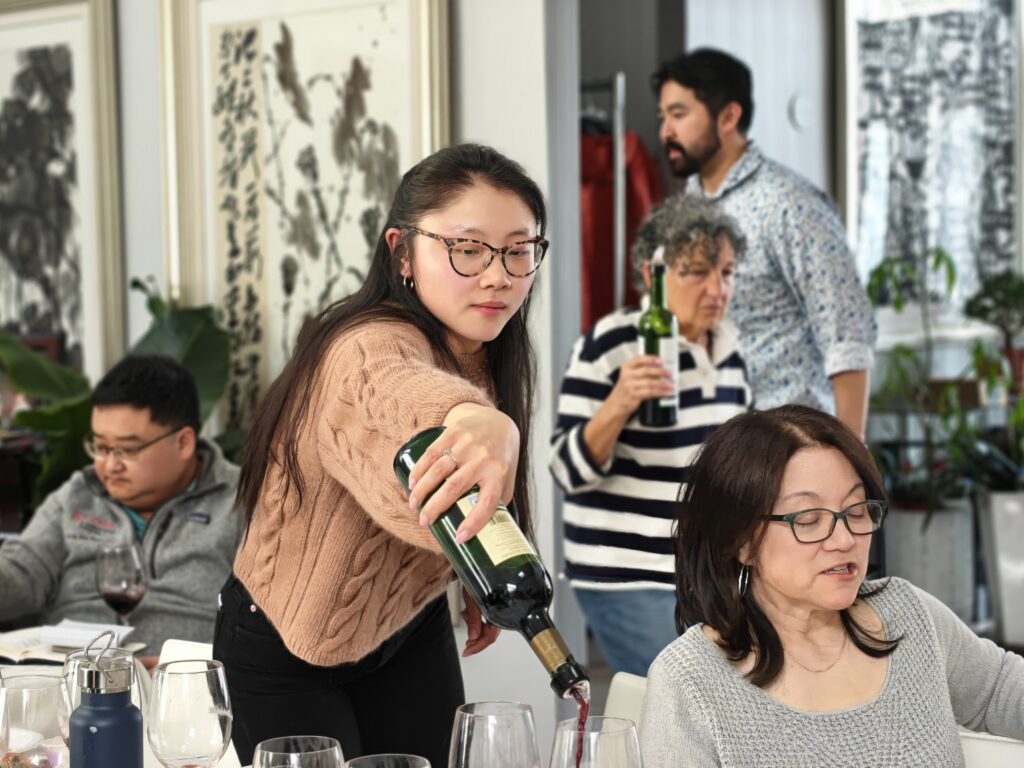
“Our first meeting was a group of eight. We hardly knew anything about wine and it was a BYOB. It was just friends hanging out over a couple of bottles and we immediately set a date for our second meeting.”
In the meantime, Wang learned an important lesson. She and her husband and fellow organizer, Brandon Win, 32, visited a more-serious society to learn more about wine. “And when we first went there, we noticed people were not actually connecting on any level beyond the wine. So for The Winer Things, we just wanted to emphasize that the social aspect, the friendship, is more important than the wine.”
The Winer Things has grown to about 40 people. Wang and Win run into people at wine events who they think would be fun and invite them. Most of the members had never met most of the other members. It’s a diverse group in every way, Wang said. “I think it’s given us the ability to become better friends with so many people that we really probably would’ve just seen once and never seen again.”
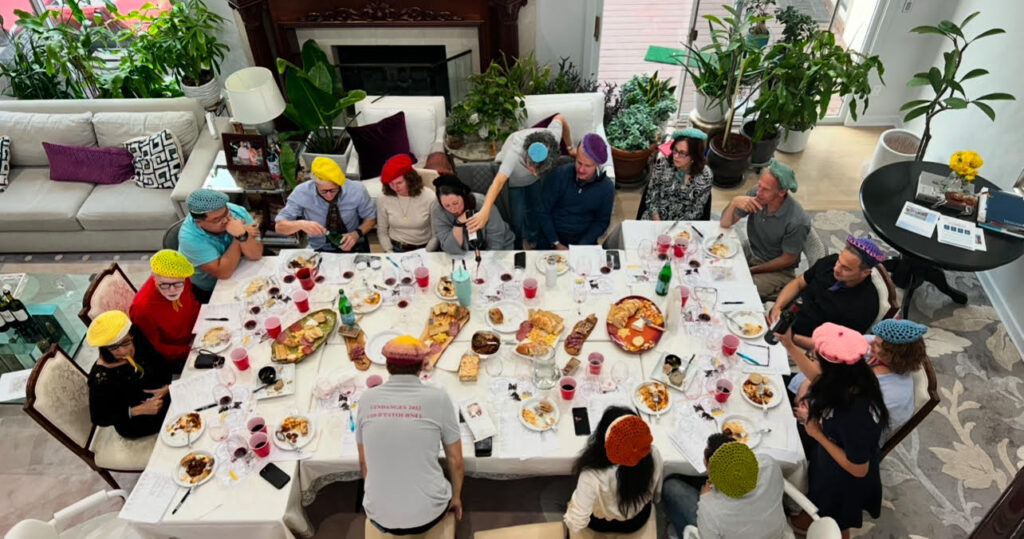
They now meet once a month. A member will propose a theme, buy the wines and everyone will split the cost. That member presents the wines and talks about the theme. Among recent events: a French tasting at which everyone wore berets and a vintage taste-off with a newer and older vintage of the same wine. They do a bubbly tasting every winter.
At our own tastings years ago, we took all of our notes by hand. The Winer Things uses an app called Slido word cloud. Tasters write their notes on their phones and the notes display on a screen in front. “Tasting notes just pop up as people submit them,” Wang said. “For example, if everyone gets jasmine, then the jasmine word gets bigger and bigger… People have been loving it for engagement. And as the tasting goes along, the tasting notes get crazier and crazier.”
In Atlanta, pastoral psychotherapist RobinLee Fitch coordinates a group called Fellowship of the Grape, “affectionately referred to as FOG,” she wrote us. Its core participants are members of Central Congregational United Church of Christ, but all are welcome to the BYOB gatherings– non-church members and even people who don’t drink alcohol. The latter may bring their favorite non-alcoholic beverage. FOG usually meets the first Saturday of the month, and attendance, Fitch said, has ranged from 45 people to as few as six including the hosts, who choose the theme. She hosts every January and one theme has been “your favorite wine to celebrate with” and another was “what wine was your first in the spirit of new beginnings.”
Tastings are held in homes or condo community rooms. The church’s bulletin and other platforms have a notice for June’s tasting of red and white wines from Oregon and Washington. The notice reads: “Please bring a sweet or savory appetizer or dessert choice for 8 to 12 people to add to the spread. For those not familiar with FOG, attending is the best way to meet Central’s members and visitors of all ages and stages of life in a casual setting. The tastings are informal and informative.”
Now is a great time to start a tasting group. People are looking for connection and also, we think, distraction. Not only that, but there are so many interesting wines from around the world that it’s more possible than ever to do a tasting of, say, Greek whites or Sicilian reds or worldwide Cabernet Franc. Here are some starter tips from The Winer Things’ Wang:
“It’s important to set an inclusive and friendly tone across every single event. Key to success: Make sure that every attendee feels welcome at all times.”
We’d emphasize that. Just one wine jerk in a group spoils it for everybody. We have been at too many tastings over the years when one show-off shuts down everyone. It’s important to avoid those people if at all possible. (Or maybe have a code word people can blurt out if they feel anyone is being too aggressive. “Porcupine!”)
Wang says: “The organizer really needs to have the time to prioritize the wine group. It takes a lot of work to schedule, keep track of RSVPs, some admin type stuff, which can add up if you’re hosting once a month. You can scale it up or down, though. Smaller groups are much easier. However, it is so worth it when you meet the most wonderful people who you definitely would not have met or become friends with otherwise.”
One more note from us: Make sure everyone has a designated driver, uses public transportation or takes a taxi at the end. At tastings, even if folks are careful to swirl and spit, it’s easy to drink more wine than usual.
Dorothy J. Gaiter and John Brecher conceived and wrote The Wall Street Journal’s wine column, “Tastings,” from 1998 to 2010. Dorothy and John have been tasting and studying wine since 1973. In 2020, the University of California at Davis added their papers to the Warren Winiarski Wine Writers Collection in its library, which also includes the work of Hugh Johnson and Jancis Robinson. Dottie has had a distinguished career in journalism as a reporter, editor, columnist and editorial writer at The Miami Herald, The New York Times, and at The Journal. John was Page One Editor of The Journal, City Editor of The Miami Herald and a senior editor at Bloomberg News. They are well-known from their books and many television appearances, especially on Martha Stewart’s show, and as the creators of the annual, international “Open That Bottle Night” celebration of wine and friendship. The first bottle they shared was André Cold Duck. They have two daughters.